








This story was originally published by Grist. Sign up for Grist’s weekly newsletter here.
The first thing Brazilian astrobiologist Rebeca Gonçalves remembers learning as a child was the order of the planets. Her uncle, an astrophysicist, also taught her all about the constellations dotting the night skies over Sao Paulo. “Ever since I was little, I have been in love with space,” she said.
That led to a career in space agriculture, figuring out how to grow food on other planets. She credits time later spent living among the Kambeba, an Indigenous tribe in the Amazon rainforest she is descended from, for her conviction that it is essential that she do more than explore distant worlds. She wants to preserve this one, too.
“It’s a very conscientious topic within the world of space agriculture science,” said Gonçalves, noting that “every single piece of research that we produce must have direct benefits to Earth.”
That ideal makes her latest research particularly timely. She and a team at the Wageningen University & Research Centre for Crop System Analysis found that an ancient Maya farming technique called intercropping works surprisingly well in the dry, rocky terrain of Mars.
Their findings, published last month in the journal PLOS One, have obvious implications for the possibility of exploring or even settling that distant planet. But understanding how to grow crops in the extraordinarily harsh conditions on other planets does more than ensure those colonizing them can feed themselves. It helps those here at home continue to do the same as the world warms.
“People don’t really realize [this], because it seems far away, but actually our priority is to develop this for the benefit of Earth,” said Gonçalves. “Earth is beautiful, and it’s unique, and it’s rare, and it’s fragile. And it needs our help.”
Intercropping, or growing different crops in close proximity to one another to increase the size and nutritional value of yields, requires less land and water than monocropping, or the practice of continuously planting just one thing. Although common among small farmers, particularly across Latin America, Africa, and China, intercropping remains a novelty in much of the world. This is partly because of the complexity of managing such systems and largely unfounded concerns about yield loss and pest susceptibility. Modern plant breeding programs also tend to focus on individual species and a general trend toward less diversity in the field.
This is a missed opportunity, according to Gonçalves. Evidence suggests intercropping can combat the impacts of climate change and unsustainable farming practices on yields in degraded soils, which comprise as much as 40 percent of the world’s agricultural land. “The potential of intercropping really is very high for solving some of the climate change issues,” she said.
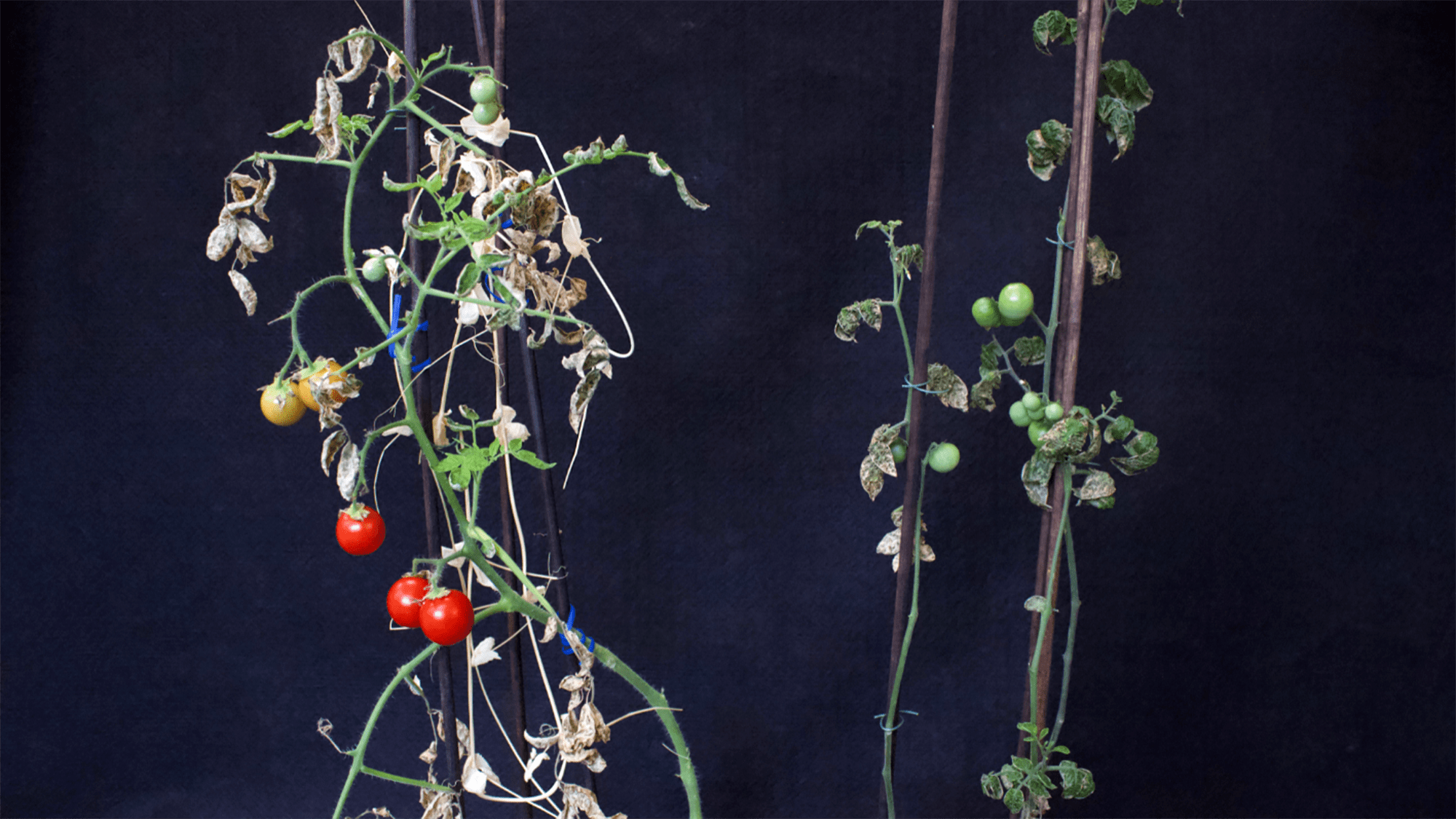
That’s why she decided to try deploying it on Mars, where the regolith — the name for dirt on other worlds — has no nutrients or biological life in it whatsoever, not unlike heavily degraded soils on Earth. Working out of a greenhouse at the university, the researchers planted a variety of tomatoes, carrots and peas in a simulation of the loose material covering the planet’s bedrock after augmenting it with a bit of nutrients and soil.
What they discovered was that although intercropping doubled the tomato yields and led to faster growth as well as thicker plant stems compared to monocropping, the carrots and peas grew better on their own. (The researchers suspect the limited amount of nutrients they added to the coarse regolith is the likely cause.) By contrast, intercropping in sandy soils — the experiment’s control, found in many regions on Earth — significantly increased yields for both the tomatoes and peas.
While the results may appear mixed, what’s remarkable is that the team could grow anything at all in the simulated regolith, which is, as Gonçalves notes, essentially “grinded stone.”
Of course, agricultural conditions on Mars, where it’s extremely cold and dry with precious little oxygen, are much more extreme than those on Earth, where climate change is prompting chronic droughts and a long-term shift to drier conditions that further depletes water supply.
And yet the dirt covering the Red Planet bears striking similarities to sandy terrestrial soil severely damaged by climate change in arid and semiarid regions around the world, including swaths of sub-Saharan Africa, northern China and southern portions of South America — breadbaskets where water scarcity and volatile rainfall patterns have in recent years led to failed harvests and reduced crop yields.
What this experiment demonstrates, according to the authors behind it, is that this could be an untapped solution to resuscitating depleted farmland — while also tackling agriculture’s widespread land use problem. Past studies have shown that, on average, intercropping with two crops needed 19 percent less land than each individual crop grown in isolation.
“Take a village in Africa that is suffering with degraded soils, and the farmers are suffering, the community is suffering. If we can have the setup that we have created for a Martian colony, it’s really no different than a small African village, because we could have the same technology there,” said Gonçalves. “It’s really endless, the possibilities that we can have for applying, almost duplicating this Martian colony system, into local communities on Earth.”
But how adaptable are solutions like these in parts of the world where they are needed most? The short answer: It’s complicated.
A 2024 paper exploring the challenges of applying technology developed for space research throughout the Global South found that, when analyzing case studies in Guyana, Tanzania, Nepal, and Vietnam, power inequalities and the exclusion of historically marginalized groups persisted because of discourses, structures, and relations stemming from historic colonial structures. This builds on past research that revealed how India’s “green revolution,” in which the country adopted modern methods of industrializing farming, led to unintended agricultural and health consequences for small farmers.
Gonçalves’ work is part of a rapidly growing body of research in space agriculture driven by billions of dollars of investment and the keen attention of governments, policymakers, and the private sector.
Just two years ago, a team at the University of Florida published a landmark paper revealing how it grew thale cress in lunar regolith collected during the Apollo era. That same year, scientists at Iowa State University grew turnips, radishes, and lettuce in simulated Martian regolith, while other studies nationwide reviewed deployment challenges for research experiments where crops including wheat were germinated in simulated lunar and Martian dirt. Together, these space-oriented investigations further indicate a surge in momentum for a field that seizes upon our collective fixation with other worlds, while subtly exploring solutions to an Earthbound crisis so politicized it prompts feelings of disconnection.
Although Gonçalves’ study provides a “tantalizing” look at how traditional agricultural methods could be used on Mars, it may not be the “most logical approach” there, said Gene Giacomelli. He considers soilless, or hydroponic, growing procedures the “only approach” to safely begin producing food on another planet. He is the founding director of the Controlled Environment Agricultural Center at the University of Arizona, where he has spent more than 20 years developing a greenhouse for use on the Red Planet.
Still, Giacomelli agrees that intercropping could be useful in the eroded soils of Earth, an idea that also intrigues Thomas Graham. He’s an associate professor at the University of Guelph who has studied space farming since 1997 and believes Gonçalves’ work underscores “the importance of quality soils to a reliable food supply, both on Earth where soils are under considerable pressure, as well as in future space applications.”
Early in his career, he was involved in a project funded by NASA to build a small greenhouse in the high Arctic tundra of Canada, a “Mars-analogue site” known for its unforgiving conditions. While there, he witnessed the “horrendous food insecurity issues” facing those living in some of Canada’s northernmost remote communities. “Getting fresh food up there is very difficult, if you can get it at all,” he said. “And it’s horribly expensive.” This led him to explore technological solutions to the challenge of growing crops in the most extreme of extreme environments — outer space.
“I’ve been fortunate to be able to help explore space while helping people ensure that they have a meal to eat,” said Graham. “It also helps with my way to contribute to helping society adapt to the mess that we’ve made with climate change.”
Solutions like greenhouses developed for colonizing other worlds could, according to Graham, be deployed in drought-ravaged areas on Earth “the very next day” after they’re devised.
Of course, achieving that in a way that benefits the people that could use it most will rely upon the right combination of funding, political will and inclusive adoption. Without that impetus, the widespread application of these kinds of agricultural techniques may be almost as far away as our capacity to feed those who one day populate the cosmos.
This article originally appeared in Grist at https://grist.org/food-and-agriculture/why-a-new-method-of-growing-food-on-mars-matters-more-on-earth/.
Grist is a nonprofit, independent media organization dedicated to telling stories of climate solutions and a just future. Learn more at Grist.org









Discussion about this post