









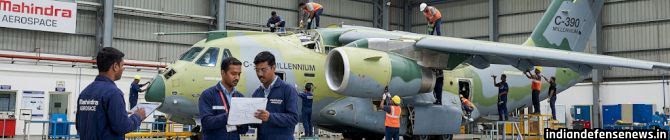
Embraer Looks to India as a Strategic Manufacturing Hub for C-390 Millennium Aircraft
Embraer, the prominent Brazilian aerospace manufacturer, is setting its sights on India not just as a client for its C-390 Millennium military transport aircraft but as an emerging manufacturing and export center for the Asian market. This strategy could position India to meet a significant portion of regional demand for military transport solutions.
Collaborating with Mahindra Group, Embraer anticipates that Asia could fulfill 40-45% of worldwide demand in the military transport segment, estimating a need for approximately 500 aircraft over the next 20 years. Embraer Defence & Security CEO Bosco da Costa Junior emphasized that the company views India primarily as an industrial ally rather than merely a purchaser, aiming to leverage Indian manufacturing to support future regional exports.
Focus on Indian Air Force’s Medium Transport Aircraft Program
The immediate objective centers on the Indian Air Force’s Medium Transport Aircraft program, under which India plans to acquire 60 aircraft, with an estimated financial commitment of around ₹1 lakh crore. Competing for this lucrative contract, Embraer and Mahindra propose the C-390 Millennium, enhanced by commitments to localized manufacturing and supply-chain development.
According to the program’s stipulations, the successful bidder must deliver the first 12 aircraft as fly-away units, while the remainder is expected to be produced domestically. Importantly, the aircraft must comprise at least 40% indigenous content, and the total contract execution is anticipated to span 11 years, with bid submissions due by January 13.
Proposed Assembly Line in Nagpur
If the C-390 is chosen, Nagpur has been identified as the preferred site for establishing a final assembly line. Plans involve not just aircraft assembly but also systems integration, manufacturing engineering, and the development of a robust supplier network within India. Furthermore, potential maintenance, repair, and overhaul capabilities are being discussed, contingent on securing the Indian order; no production line has been officially confirmed as of now.
Capabilities of the C-390 Millennium
The C-390 Millennium is a versatile twin-engine transport aircraft capable of fulfilling various missions, including cargo logistics, troop deployment, airdrop operations, medical evacuations, search and rescue missions, firefighting, and humanitarian aid. The aircraft boasts a maximum payload capacity of 26 tons and can operate from temporary or unpaved runways, enhancing its appeal as a modern multi-role platform.
Evaluation Criteria for the Indian Air Force
India’s evaluation process will likely consider more than just the aircraft’s capabilities. Key aspects will include operational efficiency, acquisition and lifecycle costs, delivery timelines, and comprehensive performance against the Indian Air Force’s specific requirements.
International Reach and Competition
The C-390 has been steadily growing its international clientele, with Sweden placing an order for four aircraft and the Netherlands and Austria collectively ordering nine. The aircraft is already operational with Brazil, Portugal, and Hungary, contributing to Embraer’s expanding export portfolio.
However, Embraer faces stiff competition, primarily from Lockheed Martin’s C-130J Super Hercules, in partnership with TATA Advanced Systems. The Indian Air Force currently operates 12 C-130Js, which have been utilized effectively in strategic missions, especially in Ladakh. This existing operational familiarity and established local manufacturing infrastructure provide Lockheed Martin and TATA an edge in the bidding process.
Implications for India’s Aerospace Industry
While Lockheed Martin and TATA are leveraging their established presence in India, Embraer is attempting to distinguish its offering by emphasizing larger-scale domestic production and future export potential. The stakes extend beyond simply acquiring transport aircraft; for India, this represents a crucial examination of whether a significant military aviation procurement can also bolster domestic aerospace manufacturing.
For Embraer and Mahindra, winning this contract would not only serve as a catalyst for establishing the proposed Nagpur facility but also support ambitions for capturing additional sales across Asia. While the demand projection for 500 aircraft points to a promising commercial opportunity, the success of this initiative ultimately hinges on securing the Indian Air Force contract.
Agencies






Discussion about this post