









Understanding Cybersecurity Risk Assessments
Organizations may implement various security measures such as firewalls, endpoint protection, and security monitoring, yet still overlook critical vulnerabilities that could jeopardize their operations. For instance, while a customer database may be secured with stringent access controls, an outdated supplier account could still have access to sensitive information. Conducting a cybersecurity risk assessment is essential to identify such gaps.
This evaluation process pinpoints crucial systems and data, assesses potential threats, and prioritizes security enhancements based on their likely impact on the business.
This article outlines the components of a cybersecurity risk assessment, frameworks that can aid the process, and a step-by-step guide to conducting one. Additionally, it addresses how to evaluate the security of AI systems and applications that organizations increasingly depend on.
What Is a Cybersecurity Risk Assessment?
A cybersecurity risk assessment is a systematic approach to identifying an organization’s key assets, evaluating threats and vulnerabilities, and estimating the potential likelihood and impact of incidents. This assessment enables organizations to prioritize risks and determine which security measures are necessary to mitigate them.
The result is a prioritized list of risks, detailing their business impacts, existing controls, and recommended actions. Common strategies for managing these risks include avoidance, reduction, transfer, or acceptance. It is important to note that transferring risk, such as through insurance, does not absolve the organization of its responsibility to manage it.
A comprehensive assessment answers four critical questions:
- What assets are worth protecting?
- What threats could harm them, and how?
- What is the likelihood of these threats, and what would their impact be?
- What actions should be taken, and in what order?
Importance of Cybersecurity Risk Assessments
1. Prioritizing Security Investments
Without a clear understanding of risks, organizations may allocate resources to visible security issues while neglecting more significant vulnerabilities. A risk assessment directs funding towards the most critical issues.
2. Compliance and Auditing Support
Many regulations mandate documented risk analysis and management processes. For instance, HIPAA requires thorough risk analyses of electronic protected health information, while ISO 27001 outlines the need for an information security risk assessment framework. Compliance with standards like SOC 2 and PCI DSS also necessitates formal risk identification and management strategies.
3. Enhanced Visibility for Leadership
A prioritized risk register provides senior management with insights into which systems face exposure, the potential consequences, and areas that require investment.
4. Monitoring Security Enhancements
Regular assessments allow organizations to evaluate the effectiveness of controls, identify changes in risk landscapes, and address unresolved issues.
Cybersecurity Risk Assessment Frameworks
Organizations need not develop their methods from scratch; established frameworks and standards can guide the identification of risks and evaluation of security controls. Common frameworks include:
- NIST Cybersecurity Framework (CSF) 2.0: Organizes cybersecurity outcomes into six functions: Govern, Identify, Protect, Detect, Respond, and Recover, providing a flexible structure for risk management.
- NIST SP 800-30: Offers detailed guidance for conducting risk assessments, including preparation, analysis, communication, and maintenance.
- ISO/IEC 27001 and ISO/IEC 27005: ISO 27001 specifies requirements for an information security management system (ISMS), whereas ISO 27005 provides risk management guidance.
- CIS Critical Security Controls: A prioritized set of cybersecurity safeguards that assist organizations in strengthening their defenses based on assessment findings.
Organizations can select a primary framework and map findings to additional standards as necessary, ensuring consistency and clarity in results for security teams, leadership, and auditors.
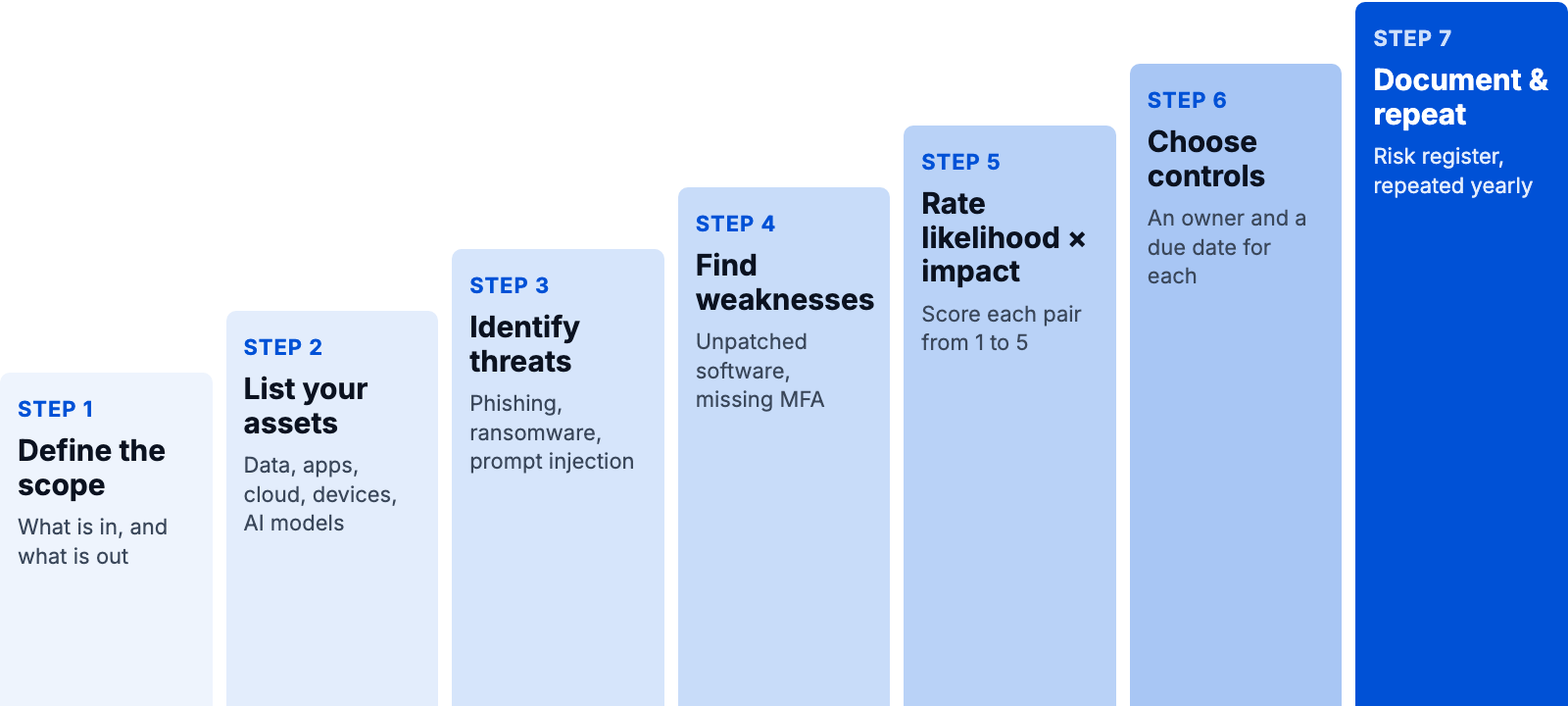
Conducting a Cybersecurity Risk Assessment in 7 Steps
Step 1: Define the Assessment Scope
Determine the extent of the assessment—whether it encompasses the entire organization, a specific business unit, or a particular system. Identify all relevant locations, applications, data, networks, cloud environments, and third-party services.
Step 2: Inventory Your Assets
Create a comprehensive inventory that includes customer and employee data, applications, cloud accounts, devices, networks, third-party services, and AI models. For each asset, note its owner, location, sensitivity, and operational importance.
Step 3: Identify Cybersecurity Threats
Catalog potential threats to each asset, such as phishing, ransomware, insider threats, and specific risks related to AI systems. Go beyond general categories to consider how each threat may specifically impact your organization.
Step 4: Identify System Vulnerabilities
Examine weaknesses that could be exploited by identified threats, including unpatched software, inadequate access controls, and poor logging practices. Conduct vulnerability assessments or penetration tests to gather evidence of potential weaknesses.
Step 5: Evaluate Risk Likelihood and Impact
For each identified threat and vulnerability pairing, estimate the likelihood of occurrence and the potential impact. This can be done using a simple rating scale, ensuring that the impact assessment considers more than just financial loss.
| Likelihood × Impact | Low Impact (1–2) | Medium Impact (3) | High Impact (4–5) |
|---|---|---|---|
| High Likelihood (4–5) | Medium | High | Critical |
| Medium Likelihood (3) | Low | Medium | High |
| Low Likelihood (1–2) | Low | Low | Medium |
Step 6: Select Security Controls and Assign Risk Owners
For each significant risk identified, decide on a strategy—whether to avoid, reduce, transfer, or accept it. Identify appropriate controls and assign accountability for implementing the necessary actions.
Step 7: Document Findings and Review Risks Regularly
Maintain a risk register that captures all findings, including asset details, threat scenarios, vulnerabilities, likelihoods, impacts, risk ratings, existing controls, and treatment decisions. Summarize high-priority risks for leadership and ensure that the assessment is reviewed regularly and after significant changes.
Cybersecurity Risk Assessment vs. Vulnerability Assessment vs. Penetration Test
These processes serve different purposes, though they are often confused with one another:
| Risk Assessment | Vulnerability Assessment | Penetration Test | |
|---|---|---|---|
| Question it Answers | Which risks are most critical to the business? | What known vulnerabilities exist within our systems? | Can an attacker breach our defenses, and to what extent? |
| Method | Interviews, documents, scoring | Automated scanning, review of findings | Manual attack simulation by testers |
| Output | Ranked risk register and response plan | A list of vulnerabilities by severity | Documented attack paths and evidence |
| Frequency | Annually and after major changes | Monthly or continuously | Annually or after major releases |
Assessing AI Systems and Their Security Risks
AI systems must be included in cybersecurity risk assessments alongside other technologies. However, unique risks related to AI may not be fully addressed by traditional security protocols. Common AI risks include:
- Prompt Injection: Manipulative instructions that cause an AI system to act against its intended purpose.
- Data Leakage: The potential for AI applications to expose confidential business information.
- Excessive Permissions: AI models may possess more access rights than necessary, leading to significant risks if compromised.
- Supply Chain Risks: Third-party tools or datasets may introduce vulnerabilities.
- Vector and Embedding Weaknesses: Systems that rely on retrieval-augmented generation may inadvertently expose sensitive information.
When to Engage a Cybersecurity Risk Assessment Consultant
While organizations can conduct initial assessments internally, hiring an external cybersecurity consultant may be beneficial when facing complex requirements or needing specialized skills. Consulting services are advisable for:
- Preparing for audits, such as SOC 2, ISO 27001, or HIPAA.
- When internal teams lack the objectivity to identify vulnerabilities.
- Requiring specialized penetration testing or AI security evaluations.
- When leadership seeks an independent perspective on cybersecurity risks.
Conclusion on Cybersecurity Risk Assessments
A cybersecurity risk assessment is only valuable if it leads to actionable outcomes. Identifying risks is merely the first step; organizations must understand the business implications, select appropriate controls, and designate responsible parties to address risks. Begin with the most critical assets, analyze how threats may affect them, and prioritize addressing issues that could lead to substantial repercussions.
Regular reviews are essential as systems and business conditions evolve. For assistance in evaluating your security posture, consider engaging with cybersecurity services to enhance your risk management strategies.
Cybersecurity Risk Assessment FAQs
1. How often should we conduct a cybersecurity risk assessment?
At a minimum, assessments should occur annually and after significant changes, such as cloud migrations or major system updates. Organizations handling sensitive data or undergoing rapid changes may benefit from quarterly reviews.
2. How long does a cybersecurity risk assessment take?
An assessment of a single application may take a few days to two weeks, while a comprehensive assessment of an entire organization typically spans three to six weeks, depending on the complexity and preparedness of documentation.
3. What is the cost of a cybersecurity risk assessment?
In-house assessments primarily involve staff time and possibly tools. External assessments are priced based on scope, including the number of systems and locations involved. Fixed-scope quotes are recommended to ensure clarity on included services.
4. What distinguishes a risk assessment from a vulnerability assessment?
A vulnerability assessment identifies existing weaknesses, while a risk assessment prioritizes which of these weaknesses present significant risks to the organization and outlines appropriate actions.
5. How does a risk assessment differ from a security audit?
A risk assessment focuses on identifying and prioritizing risks for action, whereas a security audit evaluates compliance with established requirements or internal policies. Audits may reference risk assessment records as part of their evaluation.
6. Who should participate in a cybersecurity risk assessment?
Involve individuals knowledgeable about systems, business processes, and decision-making authority. This typically includes IT and security staff, data and application owners, compliance teams, vendor management, and leadership sponsors, along with AI product owners if AI systems are included.
7. Can AI assist in cybersecurity risk assessments?
Yes, AI can aid in organizing asset information, analyzing security logs, summarizing vulnerabilities, and identifying patterns. However, findings generated by AI must be validated by human experts who will assess business impact and verify evidence.






Discussion about this post