

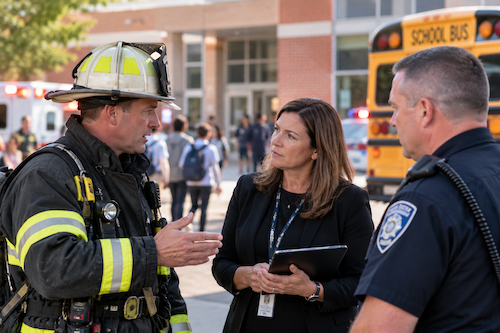
Emergency Response in Schools: Preparing for the Unexpected
As a potential school emergency unfolds, multiple parties become engaged in critical communication. A teacher conveys urgent information, a 911 dispatcher seeks essential details, and school leaders strive to comprehend the evolving situation as first responders begin to strategize with limited information.
It is in these initial moments that the trajectory of the emergency response is established.
Contrary to popular belief, the emergency response process does not commence merely upon the arrival of police, fire, or medical services at a school. Insights gleaned from over three decades in public safety—including roles as a firefighter, 911 dispatcher, supervisor, and emergency response technology professional—reveal that effective responses begin long before an incident occurs. The foundation for successful action lies in the relationships, communication strategies, and coordination established between schools and their local communities. Mastery of three core principles—speed, clarity, and coordination—ensures effective preparedness.
Speed: Minimizing Response Time
A prevalent misconception surrounding emergency response is the belief that once a call to 911 is made, responders can spring into action immediately. In reality, dispatchers face the challenge of ascertaining critical details such as the nature of the emergency, its precise location, and the resources required. This process is inherently time-consuming, particularly when callers are distressed or uncertain about the information they provide.
Minor delays—whether from searching for a phone, relaying information through multiple channels, or struggling to articulate the situation—can significantly hinder response times and adversely affect outcomes. Schools can expedite this communication by implementing structured emergency systems and response protocols that swiftly relay accurate and actionable information to dispatch centers.
Rapidly informing first responders about the specifics of a situation enables them to mobilize resources more promptly. This urgency is especially critical in rural areas, where staffing shortages and geographical distances can lead to prolonged response times. In some counties, a single officer may be accountable for over 100 square miles, with emergency medical teams often located 20 to 30 minutes away. Thus, schools in these regions stand to benefit from proactive coordination and clearly articulated procedures.
Clarity: Providing Actionable Information
A transformative shift in contemporary emergency response lies in the ability to furnish responders with comprehensive mapping data rather than merely a general location. School campuses can be intricate environments; knowing there’s an emergency at “the high school” lacks meaning without precise details, such as the specific floor, classroom, and nearest entrance for accessing assistance quickly.
In the early days of my firefighting career, we relied on paper maps due to the absence of GPS technology. I experienced a situation where our crew was dispatched to an incorrect location because a crucial update was missing from our map collection, resulting in lost time. Today, schools can enhance collaboration with first responders by ensuring that campuses are accurately mapped and operational plans are shared in advance, thus enabling informed decision-making prior to arrival.
This shared clarity also fosters efficient operations among various responding agencies, including law enforcement, fire departments, emergency medical services, and school administrators. Each entity has distinct responsibilities during a crisis, and utilizing the same information streamlines their coordinated efforts, reducing confusion during high-pressure situations.
Coordination: Cultivating Partnerships Ahead of Time
The most effective school safety initiatives are anchored in partnerships rather than being confined to extensive binders filled with emergency protocols. Effective coordination hinges on schools maintaining regular interaction with the stakeholders involved in emergency management.
This collaboration should encompass:
- Joint training exercises
- Shared campus maps and operational protocols
- Established communication channels with dispatch centers
- Routine reviews of response strategies and access points
Such efforts cultivate familiarity and instill trust. When first responders are familiar with school layouts, school leaders comprehend the emergency processes, and dispatchers can efficiently gather vital information, the overall response team operates with enhanced confidence and effectiveness.
A Collective Responsibility
The concept of situational awareness in public safety is often discussed during emergencies, yet effective preparation is a proactive endeavor that precedes any incident. While it is impossible to foresee every emergency, we can equip ourselves to handle them adeptly. Dedicating resources to foster robust community partnerships empowers all stakeholders to respond swiftly, communicate efficiently, and coordinate effectively when it matters most.
Author: Jason Klink, CENTEGIX
Jason Klink serves as the Lead Public Safety Integration Specialist at CENTEGIX and is a veteran first responder with over 30 years dedicated to public safety. His experience encompasses roles as a firefighter, 911 dispatcher, and dispatch supervisor. He collaborates with schools, healthcare providers, and public safety agencies to bolster emergency communication, coordination, and preparedness.






Discussion about this post