





Canada’s EU Relations: Calls for Clarity Amidst Confusion Over Membership Status
Experts specializing in European Union policy are urging Canada to strengthen legal frameworks with the EU amidst ongoing discussions about a potential “associate membership,” a term that has led to considerable confusion.
Insights from Academic Experts
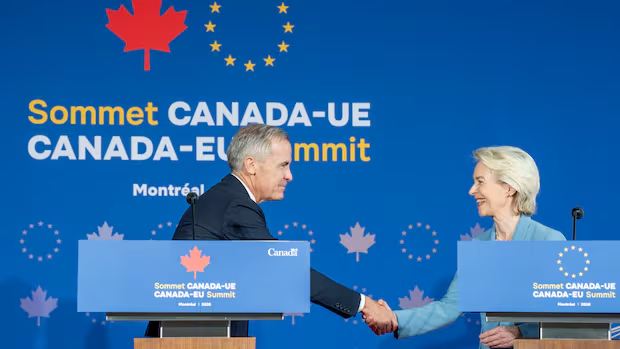
During testimony to the House foreign affairs committee on Monday, following a recent summit in Montreal involving high-ranking Canadian and EU officials, scholars raised concerns regarding the direction of Canada-EU relations. While the officials lauded the partnership plan, academic critiques emerged.
Mark Manger, a professor at the University of Toronto, expressed skepticism about the agreements, stating, “Many of these arrangements appear to be expressions of intent. I’m still waiting for a concrete announcement.” He contrasted Canada’s current aspirations with the existing agreements that Mexico has successfully established with the EU.
Uncertainty Over “Associate Membership”
The recent discussions have been muddied by mixed messaging regarding associate membership. European Commission President Ursula von der Leyen suggested that Canada could achieve this status, a notion Prime Minister Mark Carney had been cautious to embrace. However, during a recent address, Carney acknowledged the objective of pursuing associate membership, a term currently lacking an official definition.
Achim Hurrelmann, co-director at Carleton University’s Centre for European Studies, pointed out that the ambiguity surrounding the term distracts from the substantive policy work required prior to the summit. He noted that the EU had not thoroughly defined what such a status would entail within its legal frameworks.
Keeping the Momentum Alive
Despite the confusion, Hurrelmann remarked on the eagerness of Carney and von der Leyen to maintain public interest in the prospect of associate membership, indicating that it serves as a “symbolic attention” drawing conversation around Canada-EU ties.
The experts emphasized the necessity of developing an arrangement that bridges the gap between a mere political agreement and a formal status requiring extensive amendments to EU treaties and Canadian parliamentary votes. Hurrelmann cautioned, “The proposals that we have heard do not require associate membership at all to be realized,” further simplifying the path to partnership.
Internal and External Challenges
Anand Sundar, a transatlantic defense adviser at the European Council on Foreign Relations, highlighted the political maneuvering within the EU regarding associate membership, noting notable resistance from member states such as Germany. He framed these developments as a “political game” primarily aimed at the interests of the European Commission.
Hurrelmann raised alarms regarding the rise of far-right movements in Europe, which could pose challenges to further collaboration with non-EU nations like Canada. He stressed the importance of swiftly establishing a comprehensive legal agreement that solidifies the partnership.
Revamping CETA for Enhanced Benefits
Current discussions also touch on the decades-old Canada-European Union Comprehensive Economic and Trade Agreement (CETA), which remains partially entrenched as nine of the bloc’s 27 members have yet to implement the agreement fully. Issues persist, from restrictive food regulations affecting Canadian imports to complaints about Canadian dairy quotas, which hamper trade.
Scholars have pointed out that while the CETA was originally celebrated for its innovative regulatory alignment, it has not delivered the anticipated trade outcomes. Manger suggested that Canada should explore enhancing this trade deal with more robust economic parameters to create a more appealing framework for exports and investments.
Conclusion: A Path Forward
Moving forward, Hurrelmann recommended that Canada focus on initiatives within specific areas of EU jurisdiction, such as research and academic exchanges, while negotiating directly with individual EU member states on issues where they hold the most influence. He underscored the importance of bipartisan support for fostering closer ties with Europe.
Amidst these discussions, Conservative Leader Pierre Poilievre criticized the government’s clarity on international deals, labeling the Montreal summit as a poorly conceived effort meant to distract from domestic issues. He cautioned that Canada risks forfeiting its sovereignty and control over its borders if it does not approach these negotiations with caution.









Discussion about this post