Frye Solar, located in Kress (Texas), is the largest solar project built by Repsol, with nearly one million panels, a total installed capacity of 637 MW and 570 MW currently in operation.
Repsol has completed construction of its Frye Solar project, its largest photovoltaic plant to date, with a total installed capacity of 637 MW and 570 MW currently in operation. Located in the United States, the Frye Solar project was built near the city of Kress, Swisher County, Texas.
Frye Solar is comprised of almost one million solar panels. Repsol has already signed a long-term power purchase agreement (PPA) for 89% of the output from this project as part of its strategy to lock in returns for this type of asset.
“Repsol views completion of our largest U.S. renewable facility to date as a major milestone that will contribute to our commitment to become a net-zero emissions company by 2050,” said Federico Toro, Repsol’s Chief Operating Officer (COO), Low Carbon Generation North America. “Our growth ambition in this country is significant.”
Repsol’s total renewable installed and under development capacity in Texas is 2,091 MW, including the facilities at Frye (637 MW), Outpost (629 MW), and Pinnington (825 MW). In addition, Repsol already generates renewable electricity at its existing solar power plants in New Mexico, Jicarilla 1 and 2, with a total installed capacity of 125 MW and 20 MW of battery storage. Repsol entered the U.S. onshore wind market with the acquisition last year of ConnectGen from Quantum Capital Group.
Renewable energy generation is currently one of the pillars of Repsol’s decarbonization strategy. According to the Strategic Update, Repsol will invest between €3 and 4 billion to organically develop its global project portfolio and aims to reach between 9,000 MW and 10,000 MW of installed capacity by 2027. Of this, 30% will be in the United States, after consolidating the Hecate and ConnectGen project pipeline.
Renewable growth in the U.S.
Repsol entered the U.S. renewable energy market in the United States in 2021 with the purchase of 40% of Hecate Energy, a U.S. company specializing in the development of renewable power and energy storage projects.
In September 2023, Repsol acquired the 20,000-megawatt project portfolio of ConnectGen, a multi-technology renewable energy developer. The portfolio includes onshore wind, solar, and energy storage projects in the U.S. The acquisition marked Repsol’s entry into the U.S. onshore wind business.
Thanks to these transactions, Repsol advances its objectives to geographically diversify its renewables business, complementing its capabilities, improving its portfolio and creating a solid platform with great growth potential.
Repsol is a global multi-energy company committed to reaching net zero emissions by 2050. Present throughout the energy value chain, it employs 25,000 people, distributes its products in more than 90 countries, and serves 24 million customers. Repsol is a major player in the Spanish energy retail market, with more than two million customers, boasts a global renewable energy portfolio of more than 2,800 MW in operation and has 60GW projects of wind and photovoltaic facilities in Spain, the United States, Chile, Italy and Portugal.
Happiest Minds has established its role as a long-term development partner in ENERCON’s pioneering efforts to expand onshore wind energy.
Happiest Minds Technologies Limited (NSE: HAPPSTMNDS), a ‘Born Digital . Born Agile’, Mindful IT Company, today announced the strategic collaboration with ENERCON, a leading wind energy technology company.
Happiest Minds has established its role as a long-term development partner in ENERCON’s pioneering efforts to expand onshore wind energy. To facilitate this journey, a distributed agile pod team has been set up to collaborate closely with their product owners, subject matter experts (SMEs), and local partners. Furthermore, Happiest Minds will focus on enhancing a specific product aimed at optimizing wind energy generation.
Joseph Anantharaju, Executive Vice Chairman & CEO of Product and Digital Engineering Services (PDES), Happiest Minds, said, “This partnership marks a significant stride toward fostering sustainable and climate-friendly industries. We have assembled a highly skilled team dedicated to supporting them every step of the way. Our digitally agile approach has been instrumental in securing this opportunity.”
Dr.-Ing. Michael Kersten, Head PSS Management R&D, ENERCON, said, “Our aim is to supply reliable, low-cost green power to industries. We are excited to work with Happiest Minds in this endeavor, due to their agility, enthusiasm for collaboration, and commitment to fostering a sustainable ecosystem.”
About Happiest Minds Technologies
Happiest Minds Technologies Limited (NSE: HAPPSTMNDS), a Mindful IT Company, enables digital transformation for enterprises and technology providers by delivering seamless customer experiences, business efficiency and actionable insights. We do this by leveraging a spectrum of disruptive technologies such as: artificial intelligence, blockchain, cloud, digital process automation, internet of things, robotics/drones, security, virtual/ augmented reality, etc. Positioned as ‘Born Digital. Born Agile’, our capabilities span Product & Digital Engineering Services (PDES), Generative AI Business Services (GBS) and Infrastructure Management & Security Services (IMSS). We deliver these services across industry groups: Industrial, Manufacturing and Energy & Utilities, Healthcare & Life Sciences, Retail, CPG & Logistics, Banking, Financial Services and Insurance (BFSI), Hi-Tech and Media & Entertainment, and EdTech. The company has been recognized for its excellence in Corporate Governance practices by Golden Peacock and ICSI. A Great Place to Work Certified™ company, Happiest Minds is headquartered in Bangalore, India, with operations in the U.S., UK, Canada, Australia, and the Middle East.
About ENERCON
As a pioneer of wind energy technology and a committed supporter of the energy transition, we have specialized in developing, producing, selling and servicing onshore wind turbines. Pursuing our mission of ‘Energy for the world’, we have been championing sustainable energy generation from onshore wind since 1984. Thanks to our innovative wind turbine technology, high quality standards and many years of experience, we are one of the industry’s leading manufacturers anywhere in the world.
According to most metrics, economic inequalities across the world have been declining since the late 1980s.
This has been driven by decreasing inequalities between countries – due to rapid economic growth in Asia – and has occurred despite increasing inequalities within a number of countries.
However, this trend could be reversed by the impacts of climate change.
While the repercussions of a warming climate are being felt in all corners of the world, the scale of these impacts on different countries, regions, communities and individuals varies hugely. The degree of economic inequality in the future will largely depend on how well different groups can adapt.
In a new review study, published in Environmental Research Letters, we analysed the existing literature and gathered evidence on whether, where and how climate change exacerbates economic inequality.
We find robust evidence that climate change impacts do indeed increase economic inequality and disproportionately affect the poor – both globally and within countries on all continents.
Climate change increases inequalities locally and globally
Our review covers 127 peer-reviewed studies into climate change and inequality.
These research papers cover a wide range of geographies, climate impacts, types of economic inequality measured (such as income disparities, differences in consumption or welfare disparities), methods used (such as econometric models or surveys) and findings.
The vast majority of studies confirm that climate change is exacerbating economic inequalities or hitting the poorest the hardest. This finding holds true across regions, types of physical impacts, sectors, types of inequalities and assessment methods. It is particularly prominent in studies that compare the impact of climate change across countries.
There are only two studies that find that climate change reduces inequality, but they focus on specific local circumstances – that is, flooding in Pakistan or price disparities among fishers and traders in Mexico.
Similarly, four papers find that the wealthy – whether households or countries – are more affected by climate change than the poor. However, these instances are exceptions and mostly limited to specific circumstances. For example, one study shows that the tropical cyclone Bulbul in Bangladesh caused higher losses for richer shrimp farmers, because they had larger farms.
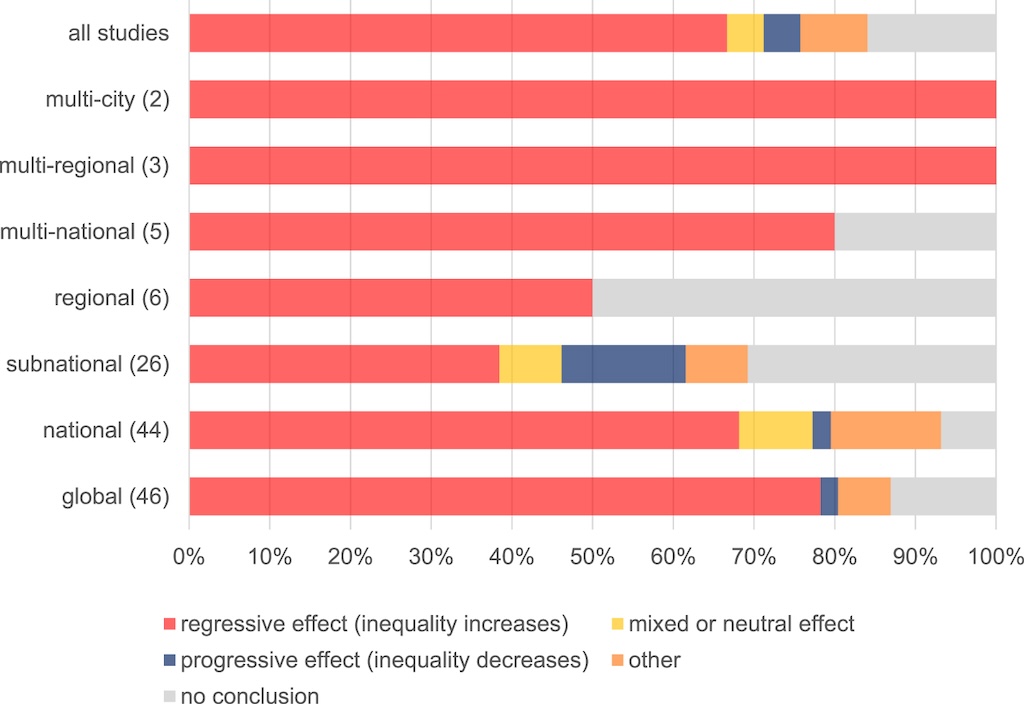
The chart below summarises these overarching results across the 127 studies, categorised by the percentage of studies showing a negative (red), positive (blue) or mixed (yellow) impact on inequality. Orange indicates a finding that does not fit one of the categories, while grey shows studies that could not reach a conclusion.
The different bars represent the geographical focus of the different studies. Most of the studies we reviewed either look at the global picture (46) or focus on individual countries (44).
Effect of climate change on economic inequality according to geographical scope of the studies in our review. These are categorised as regressive (red), progressive (blue), mixed (yellow), other (orange) or no conclusion (grey). Note that the x-axis gives the share of occurrences within studies at that geographical scope, while the number between brackets indicates the total number of studies in that category. Source: Méjean et al. (2024).
When it comes to global studies, the consensus is that climate change is widening inequalities or affecting the poor the most, with around 78% of the papers reaching this conclusion.
Some studies also highlight other groups being disproportionately impacted by climate change, such as rural communities, urban populations, women or specific regions and sectors.
However, there’s a minority of papers that remain inconclusive about both the impact of climate change on inequalities and which groups are most affected.
When it comes to national studies, the trend remains consistent: around 68% of these papers find that climate change is driving up economic inequality or hitting the poorest the hardest (30 out of 44 papers).
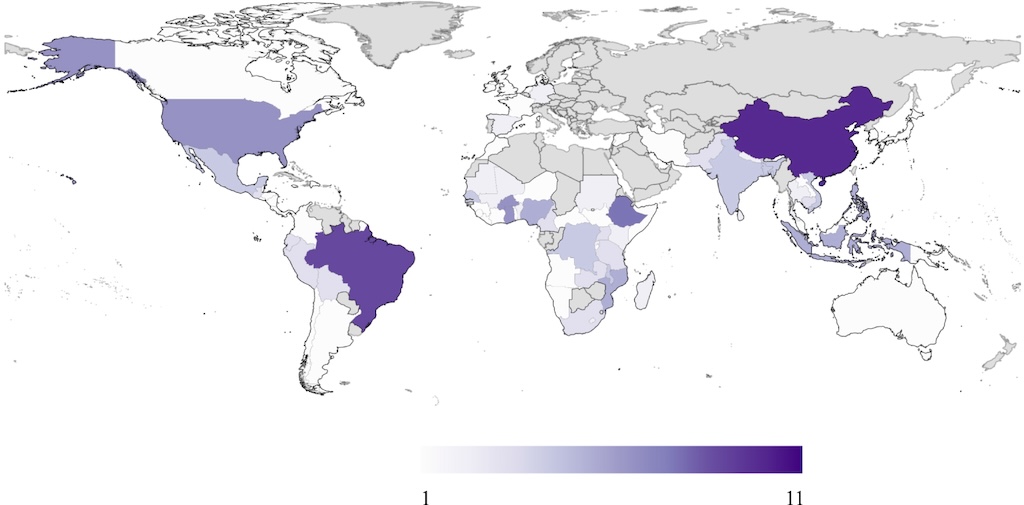
As the map below shows, this holds true in all parts of the world. The purple shading indicates the number of studies finding a negative climate impact on inequality for each country.
Map of countries where studies show a regressive effect (that climate change increases economic inequality or that the poor are more impacted). This map includes studies with a national or subnational scope and multi-country studies where that result is valid for single countries. This map excludes global studies. Source: Méjean et al. (2024).
The countries with the highest number of studies (more than five) showing that climate change increases economic inequality or disproportionately affects the poor are China, Brazil, Ethiopia and the US.
Different climate impacts contribute to inequality
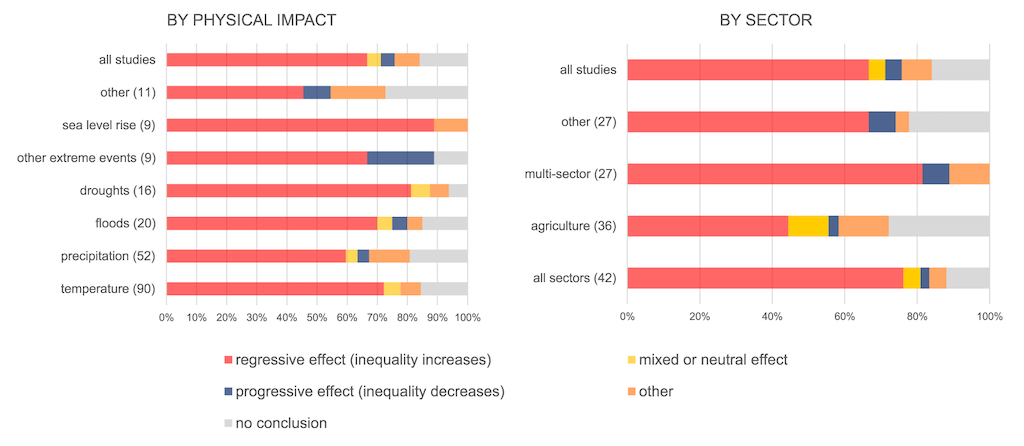
Looking at the breakdown of studies, we found that the percentage of papers pinpointing a particular climate impact as exacerbating inequality or affecting the poor more significantly ranges from 60% for changes in rainfall to 89% for sea level rise.
You can see this in the left-hand chart below, which shows the findings of the literature review separated by climate impact. The right-hand chart shows the findings separated by sector. The categories are the same as in the earlier chart.
Impact of climate change on economic inequality by physical impact (left) and channel (right). These are categorised as regressive (red), progressive (blue), mixed (yellow), other (orange) or no conclusion (grey). Note that the x-axis gives the share of occurrences within studies for a given category, while the number in brackets indicates the total number of studies in that category. The sum of those numbers may differ from the total number of papers (127), as some papers may fall into several subcategories, for instance in the case where several types of physical impacts are discussed in a single paper. Source: Méjean et al. (2024).
A majority of studies focus on the impact of rising temperature, with 72% of these concluding that temperature changes worsen economic inequality or affect the poor the most.
Most of the studies that find a reduction in inequality concern extreme weather events. This is often because these studies assess the impact on physical assets, which are predominantly owned by the wealthiest.
There are several channels through which biophysical climate change impacts translate into economic effects. These channels include broad economic effects that influence all sectors, changes in agricultural revenues due to factors such as crop yield declines, impacts on labour productivity, changes to infrastructure and physical assets, shifts in energy demand or water availability.
We found that studies identifying labour productivity or energy as the main channel through which climate change affects economic inequalities overwhelmingly conclude that inequalities increase or that the poor are more impacted.
A decline in labour productivity may indeed increase inequality if it disproportionately affects low-skilled workers, especially those who work outdoors or in non-air-conditioned environments.
Notably, a large proportion of the studies where physical assets are identified as the main channel suggest that inequality actually decreases due to climate change or that the wealthy suffer more. This is because rich individuals tend to face greater losses due to the higher value of their property.
Tackling climate impacts on inequality
Our investigation into the impacts of climate change on economic inequality was motivated by the need to better understand the climate change impacts are distributed across the world. This provides the other side of the coin to the effects of mitigation policies on inequality, which are often more widely discussed.
The evidence strongly indicates that the impacts of a warming climate are regressive across countries. Tackling the impacts of climate change on economic inequality will demand substantial policy changes and financial resources.
At the national level, policymakers will need to ensure that adaptation finance and loss and damage compensation effectively reach low-income households to reduce their vulnerability and increase their resilience to climate change impacts.
The results of our review underscore the importance of policymakers integrating climate risk management strategies into the design of “climate-proof” social programmes in poor regions, which are crucial for achieving climate justice objectives.
Of course, other forms of inequality beyond economic inequality, such as gender inequality, are important and interact with climate change, but this is a topic for another review.
.shadeBg{
background: rgba(0,0,0,0.18);
}
Guest post: Mapping where tree-planting has the greatest climate benefit
Guest posts
|
26.03.24
Guest post: Climate adaptation becomes less effective as the world warms
Guest posts
|
15.03.24
Guest post: The challenge of consensus decision-making in UN climate negotiations
Guest posts
|
05.03.24
Guest post: Heavy use of CO2 removal would trigger high sustainability risks
DELIVERS NEW BENCHMARK IN MODULARITY, PERFORMANCE, ROBUSTNESS AND EXPANDABILITY
For Immediate Release
Contact: Judi Handel
McNeil, Gray & Rice
617-367-0100 ext.122
Judi.handel@mgr1.com
SAKOR Technologies Inc., a recognized leader in the area of high-performance dynamometer systems, announces the release of the DynoLAB™ GenV next generation test automation controller, which allows even a non-programmer to implement complex test systems and testing standards. Delivering a new benchmark in modularity, performance, robustness, and expandability, DynoLAB GenV is built on the latest Windows technologies and development tools in full compliance with current information technology standards.
The new DynoLAB GenV can be used with a wide array of hardware, including power analyzers, resistance meters, high potential (hi-POT) testers, ECU’s, video control units, and emissions analyzers. The fully networked test automation controller can operate several different devices independently, so users can perform multiple tests simultaneously, often with a single DynoLAB GenV controller.
Each DynoLAB GenV execution unit is an independent module, which provides superior software robustness. The system is completely scalable, so performance takes advantage of faster processors, larger memory, and more processor cores as they become available.
The powerful new automation controller features multi-monitor, multi-window, and multi-tabbed displays that allow the test sequence to be laid out in the most appealing and ergonomic manner. With its modern intuitive interface and powerful graphical test sequence editor, test engineers and technicians can easily design and implement complex automated test sequences without the need to learn a programming language or employ a professional programmer. Tests can be edited or created online or offline and the user interface and displays can be modified while the test is executing. Users can export test sequences, hardware channel sets, and unit definitions for offline test editing. SAKOR uses its advanced user experience feature to teach operators and engineers how to quickly configure and run tests.
“We are excited about the launch of our new DynoLAB GenV product,” said Randal Beattie, president of SAKOR. “Building on our decades of testing experience, the new controller allows customers to automate much larger and more complex systems than ever before, with a cost and expandability not available in the market until now.”
About SAKOR Technologies Inc.
SAKOR Technologies Inc. is a recognized leader in the manufacture and development of reliable and cost-effective automated test instrumentation systems for a wide range of applications. For over 35 years, the company has been providing quality products and superior customer service to a variety of markets including automotive, hybrid and electric vehicle, military, aerospace, marine, heavy equipment, performance racing, electric motor, consumer appliance and more.
For more information, contact us at 989-720-2700, via e-mail at: info@SAKOR.com, or visit SAKOR’s website at www.sakor.com.
Product or service trademarks mentioned herein are the trademarks of their respective owners
Welcome to Carbon Brief’s DeBriefed. An essential guide to the week’s key developments relating to climate change.
This week
‘Historic’ court victory
FIRST-EVER RULING: The European Court of Human Rights this week ruled that insufficient action to tackle climate change is a violation of human rights, DeSmog reported. In a “historic” judgement, the court ruled that Switzerland’s inadequate action on cutting emissions breached the rights to respect for family and private life of some of its most vulnerable citizens, DeSmog said. The case was brought by a group of 2,000 older Swiss women, BBC News reported.
PORTUGUESE CASE: The same court also dismissed a climate case brought by six Portuguese young people, finding the group had not exhausted legal action through the national courts, the Financial Times reported. Gerry Liston, the lawyer for the Portuguese youths, said that, despite the judges dismissing the case, the court’s ruling on the Swiss women’s action was “a massive win for all generations”, added the outlet.
INDIAN COURT: Also this week, India’s Supreme Court expanded the “right to life” to include “protection against adverse effects of climate change”, adding that “climate change threatens ‘constitutional guarantees of equality and health’, impacting factors such as air pollution, disease, and food security”, the Independent reported. An editorial in the Indian Express described the decision as a “call to action”, adding that the significance of the ruling “cannot be overstated”.
Heat goes on
ROASTING MARCH: March 2024 was the “tenth straight month to be the hottest on record”, reported the Associated Press. March temperatures averaged at 14.14C – 1.68C warmer than in the late 1800s, when the fossil fuel era began, according to AP. It added that “climate scientists attribute most of the record heat to human-caused climate change from carbon dioxide (CO2) and methane emissions produced by the burning of coal, oil and natural gas”.
HEAT-TRAPPING GASES: Atmospheric levels of the three most important heat-trapping gases – CO2, methane and nitrous oxide – reached record highs again last year, the Guardian reported. The global concentration of CO2 rose to an average of 419 parts per million (ppm) in 2023, while methane rose to an average of 1,922 parts per billion (ppb) and nitrous oxide climbed slightly to 336ppb, the outlet said.
‘RAISE VOICES’: Amid the records, UN climate chief Simon Stiell urged “ordinary people everywhere” to “raise their voices” over climate change in a speech in London, the Financial Times reported. Stiell warned that humanity has just two years left to “save the world”, adding “we still have a chance… but we need these stronger [national climate] plans, now”, reported the Associated Press.
Around the world
EU INVESTIGATION: The EU launched an investigation to examine “whether Chinese companies participating in wind parks across Europe may have benefited from state support from Beijing”, said the Financial Times.
BIGGEST ICEBERG: BBC News tracked the world’s biggest iceberg – more than twice the size of Greater London – which has “begun to drift at pace once more” after a “few weeks loitering on the fringes of Antarctica”.
BIGGEST ECONOMIES: G20 countries and “the multilateral development banks they fund” put £112bn into overseas fossil fuel development over 2020-2022, the Guardian reported. Despite pledging in 2022 to halt such financing, oil and gas funding “has continued at a strong pace”, the outlet added.
UK POLITICS: Politico reported that the UK’s rightwing populist party Reform, the brainchild of Brexiteer Nigel Farage, has plans to make scrapping climate policies a central part of its campaigning in the next general election.
SEVERE FLOODING: Russia and Kazakhstan have ordered more than 100,000 people to evacuate after melting snow swelled rivers beyond bursting point, leading to the worst flooding in the area for at least 70 years, reported Reuters.
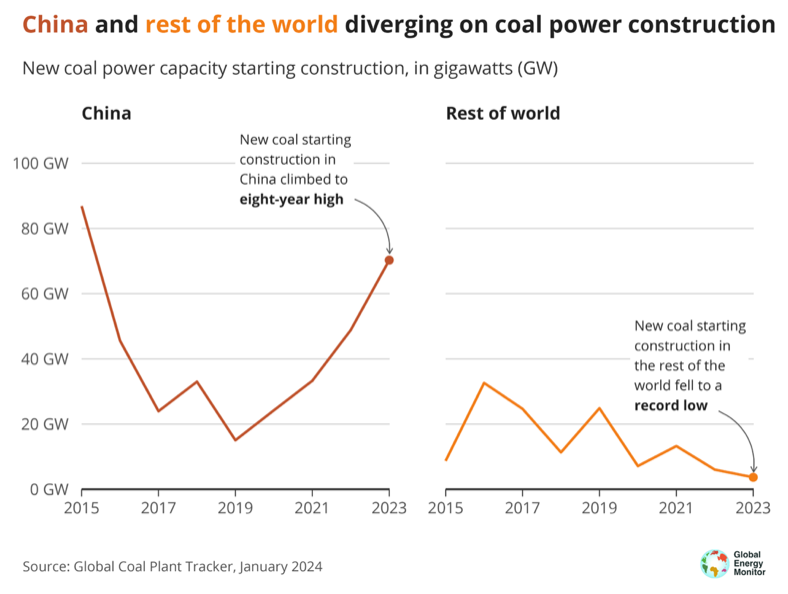
CHINA COAL: China accounted for 95% of the world’s new coal power construction activity in 2023, according to the latest annual report from Global Energy Monitor covered by Carbon Brief.
1.37m km
The total length of “ghost roads” uncovered by researchers studying deforestation in the Asian Pacific, according to Carbon Brief.
Latest climate research
A new study in Nature Climate Change warned that meteorites holding potential clues to life’s origins or the prospect of alien existence are fast disappearing from Antarctica because of climate change.
Geoengineering methods that change the planet’s radiative forcing – aiming to reduce the amount of energy that reaches the surface of the Earth – could increase the incidence of fires in the Arctic, when combined with very high greenhouse gas emissions, new research in Communications Earth & Environment suggested.
A new study in npj Climate Action found that “Roman Catholics are less likely to believe in man-made climate change as compared to evangelical Christians”. However, the more positive a respondent’s view of Pope Francis, the more likely they are “to acknowledge the effect of human activity on global warming”, it said.
(For more, see Carbon Brief’s in-depth daily summaries of the top climate news stories on Monday, Tuesday, Wednesday, Thursday and Friday.)
Captured
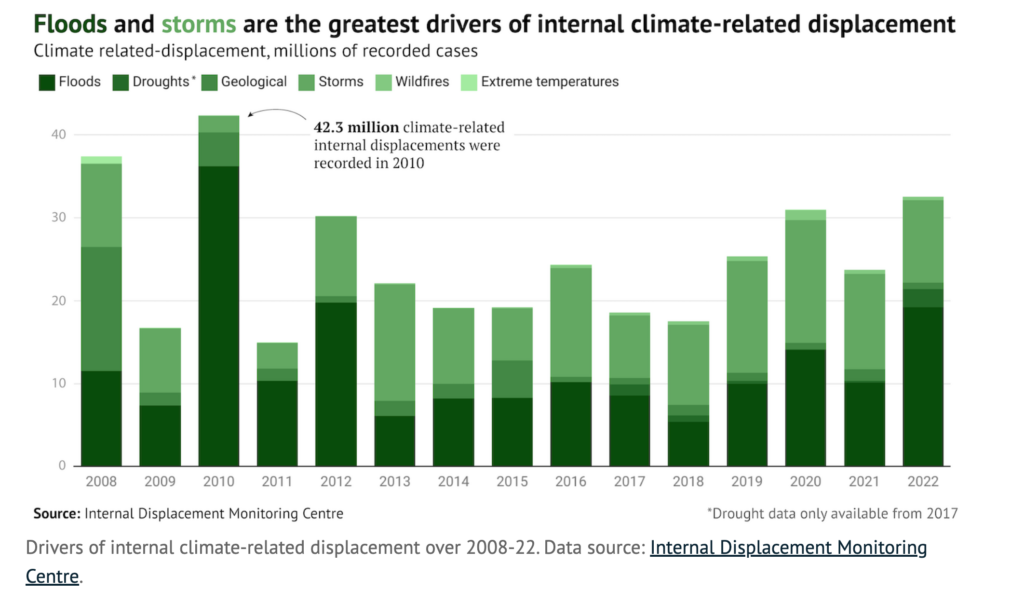
Carbon Brief has just published a two-part miniseries on the complex topic of climate migration. Carbon Brief’s explainer looked into the main drivers of why people move. Using data from the Internal Displacement Monitoring Centre (IDMC), Carbon Brief analysis showed that most climate-linked internal displacement is due to floods and storms (see above). The series also includes a special report on climate-driven migration in rural Thailand. Carbon Brief’s science journalist Ayesha Tandon also produced a video on her investigation into climate-driven migration in Thailand.
Spotlight
K-pop fans campaign for climate change
This week, Carbon Brief speaks to K-pop fans about their efforts to tackle climate change.
Dayeon Lee is a Tokyo-based South Korean student, and before discovering and joining climate campaigns, she was a “guilty” K-pop fan.
“K-pop” is a term for popular music from South Korea. K-pop has witnessed an explosion in popularity since the term first appeared internationally in the 2000s.
“I think people have the stereotype of K-pop fans, thinking we are just a group of crazy girls being obsessed with boys, but we are more than that, we are also a group of young people who care about the planet,” Lee told Carbon Brief.
“Korean entertainment companies produce a lot of album covers and we as fans buy hundreds of albums to support our idols. The companies don’t care about the environmental cost and waste, but we bear the guilt.”
Looking to make a change, Lee joined the campaign group Kpop4planet in 2021. The group, which is managed by K-pop fans, launched the campaign “No K-pop on a Dead Planet”, urging the industry to “make K-pop sustainable” and produce more eco-friendly albums.
“We had K-pop fans returning hundreds of albums to the major entertainment companies in South Korea to make sure they are aware of the issue. Although they didn’t officially respond to us, they started to introduce digital albums with purchasing code fans can scan,” said Lee.
The online campaign has in total attracted more than 100,000 people to join and they hope to inspire more.
There are an estimated 178m active K-pop fans worldwide. Kpop4planet’s campaigns cover a wide range of environmental issues, from reducing the high cost of fashion worn by K-pop singers, to protecting a beach featuring in K-pop songs and zero-emissions concerts.
“Since K-pop stars are involved with so many industries…that need to become more sustainable, we want to motivate and gather the power and influence of K-pop fans and the youth… to change the companies that are heavily polluting the environment by using fossil fuels,” said Lee.
Lee told Carbon Brief that K-pop entertainment agencies have already listened to their concerns, with some of them, such as South Korean record label JYP, committing to use 100% renewable electricity to power its operation.
‘Drop coal’
Recently, Kpop4planet decided to target the Korean motor company, Hyundai, which had signed a deal with an Indonesian company to source aluminium from a coal-powered smelter in North Kalimantan, Indonesia.
“Hyundai has a good image in Indonesia because they use the image of Korean band BTS as ‘their face’,” said Lee, adding that Kpop4planet hopes to leverage their K-pop fan stance to convince the company to “drop coal”.
Another campaigner Nural Sarifah, based in Indonesia, told Carbon Brief that the group has undertaken a “series of activities” to campaign against Hyundai’s decision, including delivering a signed petition “with a touch of K-pop dance” outside the Hyundai Motor Studio in Jakarta.
On 2 April, Reuters reported that Hyundai and its Indonesian supplier had “ended an aluminium supply agreement after calls by a climate campaigner backed by K-pop fans not to procure supplies of the metal produced using coal power”.
Hyundai announced in a statement that it had “decided to explore other opportunities independently” in Indonesia, according to the news agency. Lee told Carbon Brief:
“This move is a victory for thousands of K-pop fans who took action. We are glad that Hyundai is now exploring options to acquire transparent and sustainable sourcing materials in Indonesia.”
Lee added that their campaign will not stop there:
“Ultimately, we would like to use our collective power to [make] change. We want to secure the future that K-pop fans and the youth will inherit.”
Watch, read, listen
CHINESE SOLAR: The Financial Times published a Lex opinion piece saying “Chinese solar companies are paying a high price for victory” in a battle with European solar firms.
HAWAII’S CRISIS: CBS News released a documentary on YouTube about the water-related crisis on the Hawaiian islands.
GREEN FUNERAL: The Anti-dread Climate Podcast explored the carbon costs of traditional burial and looked for more climate-friendly alternatives.
Coming up
16-19 April: Scoping meeting for the Intergovernmental Panel on Climate Change (IPCC) special report on cities, Riga, Latvia
17 April: Solomon Islands parliamentary elections
19 April: Start of India’s general election
Pick of the jobs
The United States Department of Agriculture Forest Service Office of Sustainability and Climate, climate communications resource assistant | Salary: $750 per week and $1,000 per month housing stipend. Location: Remote (US)
European Space Agency, climate and long-term action knowledge exchange officer | Salary: Unknown. Location: Harwell, UK
Chatham House, Mo Ibrahim Foundation Academy fellowship 2024-25 | Salary: Monthly stipend of £2,365. Location: London
Institutional Investors Group on Climate Change , programme manager, nature | Salary: Unknown. Location: London
DeBriefed is edited by Daisy Dunne. Please send any tips or feedback to debriefed@carbonbrief.org. This is an online version of Carbon Brief’s weekly DeBriefed email newsletter. Subscribe for free here.
DeBriefed 5 April 2024: Southern Africa’s drought ‘disaster’; Top electric car sales slump; Is Nigeria coping with extreme heat?
DeBriefed
|
05.04.24
DeBriefed 28 March 2024: Amazon fund; China faces trade storm; How lifestyle changes could slash EU emissions
DeBriefed
|
28.03.24
DeBriefed 22 March 2024: ‘Red alert’ for Earth; Heat-pump myths factchecked; Myanmar’s rare-earth mining crisis
DeBriefed
|
22.03.24
DeBriefed 15 March 2024: Global methane surge; Europe faces ‘urgent’ climate risks; Surprising origin of Trump’s ‘drill, baby, drill’
The post DeBriefed 12 April 2024: ‘Historic’ European court victory; Climate migration explained; K-pop and climate change appeared first on Carbon Brief.
– A Consortium of Italian, Belgian, and Dutch High-Tech Innovators
– Uniting Expertise in Stack Technology (SolydEra), HotBop (Bosal), and System integration and production (VDL)
– Scaling Production and Reducing Costs
– Memorandum of Understanding Signed, Full Cooperation Agreement Expected by June
PERGINE VALSUGANA/ITALY, LUMMEN/BELGIUM and EINDHOVEN/THE NETHERLANDS, April 11th, 2024 – In response to the growing global demand for electrolyzers, industry front-runners have come together to significantly enhance production capabilities and lower costs. Today, the CEOs of SolydEra S.p.A., Bosal Energy N.V. and VDL Groep have announced their collaborative effort to advance and expand electrolyzer technology (Solid Oxide Electrolyzer) and clean power generation systems (Solid Oxide Fuel Cells). This alliance combines SolydEra’s solid oxide fuel cells and electrolysis stack proficiency, Bosal’s global leadership in developing “Hot Balance of Plants” (HotBops)—complex engineering systems essential for efficient electrolysis and fuel cell process operation—and VDL’s extensive experience in manufacturing, industrialization, and system assembly. A Memorandum of Understanding was signed today, laying the groundwork for a comprehensive cooperation agreement set to be finalized before the 2024 summer recess.
Electrolysis, the process of using electricity to catalyze a chemical reaction, is pivotal for producing essential renewable fuels like hydrogen by splitting water or steam. Hydrogen plays a crucial role in various applications, from industrial processes and synthetic fuels to fertilizer production, electricity generation, and vehicle power supply. Its potential for powering industrial operations, storing surplus renewable energy, and heating homes and businesses positions hydrogen as the “oil of the 21st century,” with significant implications for carbon emission reduction and the 2050 net-zero target.
SolydEra’s stacks achieve industry leading efficiency of 90+ percent, the company’s stack modules of 125kW are combined forming electrolyser systems of 1-100+ MW.
Dr. Martin Füllenbach, Chairman and CEO of SolydEra, stated: “To tackle our environmental urgent challenges, we’re accelerating the market introduction of our advanced electrolysis technology through our partnership with Bosal Energy and VDL. This collaboration unites industry-leading expertise to not only meet the surging global demand but also significantly contribute to the decarbonization of industrial production.”
Karel Bos, CEO of Bosal Energy, commented: “Joining forces allows us to explore opportunities more effectively when our individual strengths are as complementary as they are in this partnership. The synergy between SolydEra’s and Bosal’s mission-critical OEM capabilities, alongside VDL’s design, manufacturing and assembly capabilities, presents a significant potential to fulfill our customers’ expectations successfully.”
Guustaaf Savenije, Executive Vice President VDL Groep, added: “Reducing production costs for electrolyzers is one of our key priorities. Leveraging VDL’s manufacturing expertise and facilities, we’re ready to make a substantial contribution to our shared objective. Working alongside SolydEra and Bosal empowers green hydrogen producers and buyers to make profitable investment decisions more swiftly and confidently.”
About Bosal Energy:
BOSAL is a Tier-1 automotive supplier specialized in emission control systems and in high temperature energy conversion systems.
Capitalizing on the companies’ key expertise in development of complex systems; its ability to vertically integrate manufacturing processes from metal coil to final product; its capabilities in fluid dynamics, heat transfer, thin stainless steel metal plate forming, welding; and its knowledge of high temperature applications, BOSAL is best positioned to develop heat and flow management solutions for Solid Oxide Electrolyzers (SOEC’s) and Solid Oxide Fuel Cells (SOFC’s). The company has R&D and manufacturing facilities globally; Bosal Energy is headquartered in Lummen, Belgium. Visit www.bosal.com
About SolydEra:
SolydEra is a key world player in the market of Solid Oxide Cells, Stacks and Solutions, with the largest annual production capacity in Europe. Its Solid Oxide Technology, developed over two decades, has a proven track record and delivers best in class performance and durability in both fuel cell and electrolysis mode. The company has research & development and industrial manufacturing facilities in Italy, Switzerland and Australia. Its headquarters is in Trentino Alto Adige, Italy. Visit www.solydera.com
About VDL Groep:
Strength through cooperation. This is the cornerstone of VDL Groep, the international industrial family business with its headquarters in Brainport Eindhoven. Founded in 1953, now 70 years ago, the company has been run by the third generation of the Van der Leegte family since 2017. VDL Groep employs about 15,000 employees and operates in 19 countries. The group encompasses more than 100 closely cooperating operating companies, each with its own specialism. The activities of these companies can be summarised in the ‘five worlds of VDL’: Hightech, Mobility, Energy, Infratech and Foodtech. The combined annual turnover stood at 5.752 billion euros in 2022. Visit www.vdlgroep.com
China accounted for 95% of the world’s new coal power construction activity in 2023, according to the latest annual report from Global Energy Monitor (GEM).
Construction began on 70 gigawatts (GW) of new capacity in China, up four-fold since 2019, says GEM’s annual report on the global coal power industry.
This compares with less than 4GW of new coal power construction starting in the rest of the world – the lowest since 2014.
Outside China, only 32 countries have new coal projects at pre-construction phases of development and just seven have plants under construction.
While global coal power capacity – both overall and outside China – grew in 2023, GEM says this is likely to be a “blip” that will be offset by accelerating coal retirements in the next few years in the US and Europe.
Other key findings of the report include that construction of coal-fired power plants globally – excluding China – declined for the second year in a row. However, coal power plant retirements were also at the lowest level since 2011.
‘Pivotal juncture’ for China
In China, 47.4GW of coal power capacity came online in 2023, GEM says. This increase accounted for two-thirds of the global rise in operating coal power capacity, which climbed 2% to 2,130GW.
China’s 70.2GW of new construction getting underway in 2023 represents 19-times more than the rest of the world’s 3.7GW. As the figure below highlights, the country’s trajectory (red line) is diverging significantly from the rest of the world (orange line).
The level of new construction starting in China is nearly quadruple what it was in 2019, when the country hit a nine-year annual low of entirely new coal power stations starting.
New coal capacity starting construction shown in GW for China (red line) and the rest of the world (orange line). Credit: GEM.
This is the fourth year in a row that the amount of new coal construction starting has increased in China. This is out of line with President Xi Jinping’s 2021 pledge to “strictly control” new coal power capacity, GEM states.
In early 2022, China’s National Energy Administration’s 14th five‐year plan for a “modern energy system” stated that 30GW of coal power would be retired by 2025.
However, when counting larger coal units with capacity of at least 30 megawatts, less than 9GW of power plants have been shut down in the last three years, and few others have plans to retire, GEM notes.
If China is to meet this 30GW retirement target, it “needs to take immediate action”, GEM adds.
In a statement, Qi Qin, China analyst at the Centre for Research on Energy and Clean Air, said:
“The recent surge in coal power development in China starkly contrasts with the global trend, putting China’s 2025 climate targets at risk. At this pivotal juncture, it is crucial for China to impose stricter controls on coal power projects and expedite the transition towards renewable energy to realign with its climate commitments.”
Collectively, China, India, Bangladesh, Zimbabwe, Indonesia, Kazakhstan, Laos, Turkey, Russia, Pakistan and Vietnam account for 95% of global pre-construction capacity, according to the GEM report.
The 5% remaining is distributed among 21 countries, the tracker finds. Of these, 11 have one project and are on the brink of achieving the “no new coal” milestone, it adds.
The tracker identifies 20.9GW of entirely new coal power proposals outside of China in 2023. This was led by India, which saw 11.4GW of new coal capacity proposed, more than any year since 2016. This was in part due to the revival of several stalled projects in the country, GEM explains.
Kazakhstan also saw 4.6GW of new proposals and Indonesia saw 2.5GW. Some 4.1GW of previously shelved or cancelled capacity is now considered “proposed” again.
Another handful of countries – Russia, the Philippines, Botswana and Nigeria – also saw revived proposals and construction restarting in 2023.
Retirements slow
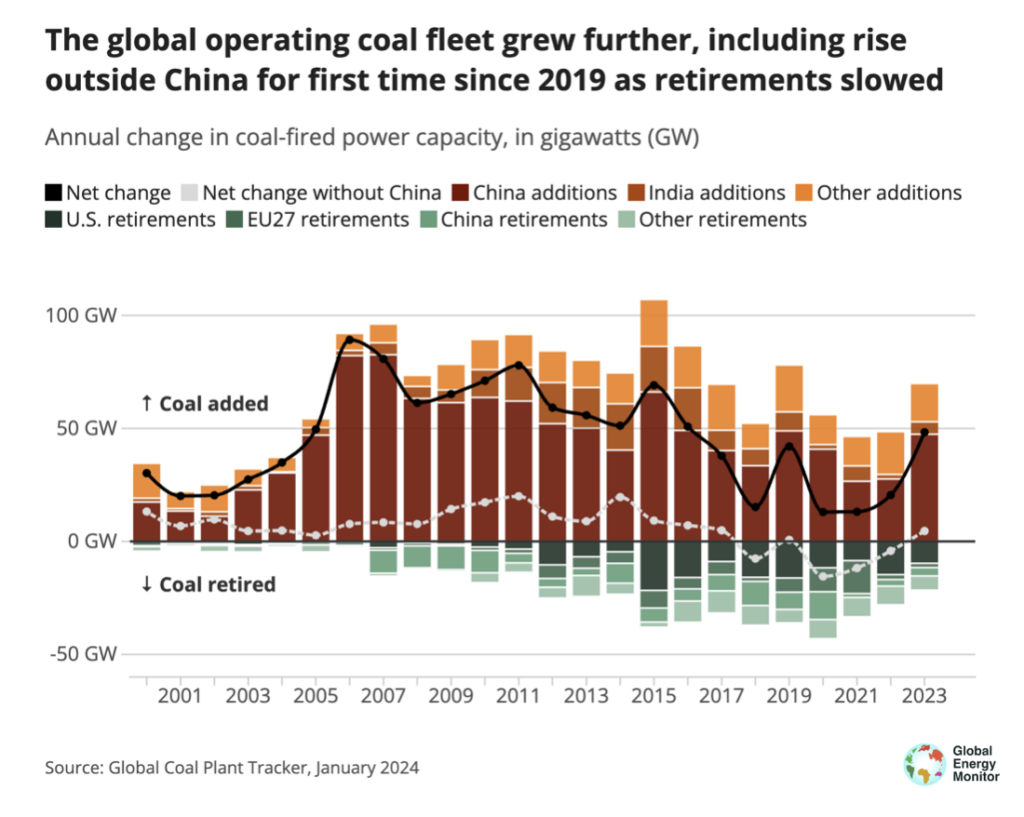
Globally, a total of 69.5GW of coal power came online in 2023, while 21.1GW was retired, GEM finds. This led to the highest net increase in global operating coal capacity since 2016, with a 48.4GW jump.
New capacity also came online in Indonesia (5.9GW), India (5.5GW), Vietnam (2.6GW), Japan (2.5GW), Bangladesh (1.9GW), Pakistan (1.7GW), South Korea (1GW), Greece (0.7GW) and Zimbabwe (0.3GW).
In total during 2023, the tracker found 22.1GW came online and 17.4GW was retired outside of China. This resulted in a 4.7GW net increase in the world’s coal fleet operating outside China. Globally, coal power capacity reached 2,130GW in 2023, up from 2% a year earlier.
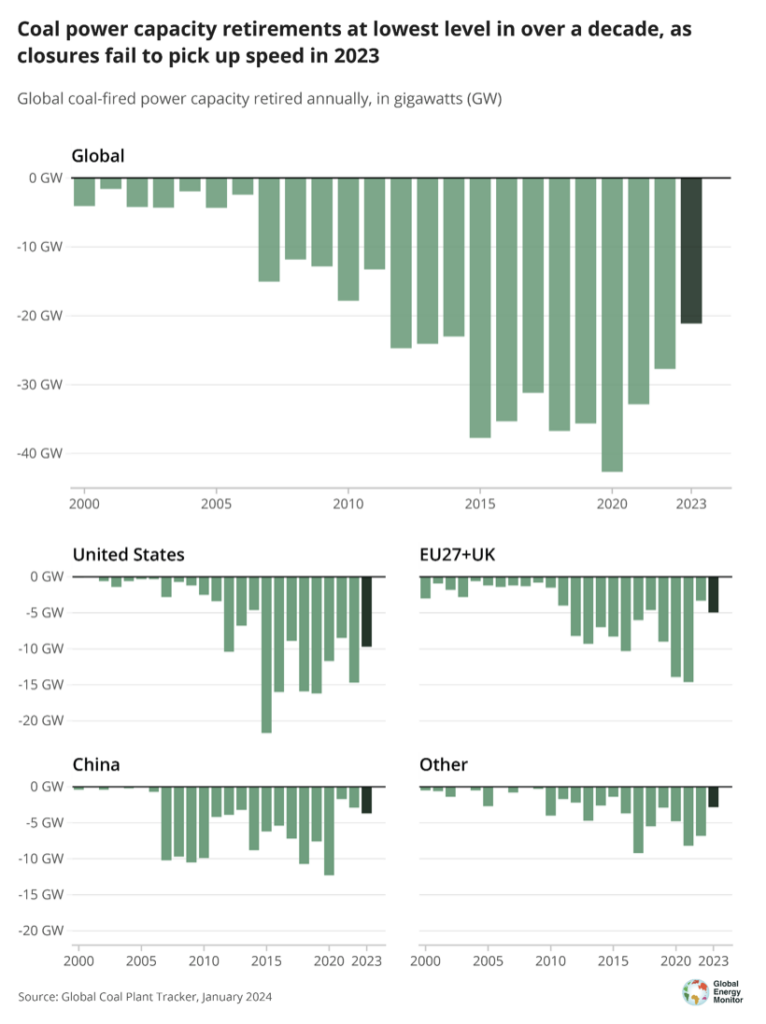
The US contributed nearly half of coal power retirements, GEM says, with 9.7GW shuttering in 2023. However, this is a drop in retirements from 14.7GW in 2022, and a peak of 21.7GW in 2015.
Elsewhere, the EU and UK represented nearly a quarter of retirements, with 3.1GW closing in the UK, 0.6GW in Italy and 0.5GW in Poland. There is now just one operating coal-fired power plant in the UK, with the Ratcliffe-on-Soar set to close in September 2024.
Overall, global coal power plant retirements were at their lowest level since 2011, as the figure below shows.
Coal-fired power station capacity annual retirements in GW, shown globally, in the US, the EU27 and UK, China and other. Black bars indicate 2023 data. Credit: GEM.
Outside of China, the number of coal-fired power plants starting construction declined for the second consecutive year, hitting its lowest level since data collection began in 2015, GEM notes.
Less than 4GW of new projects began construction outside of China in 2023, far below the average of 16GW between 2015 and 2022. Just seven countries started construction, with one plant each in India, Laos, Nigeria, Pakistan and Russia, as well as three plants in Indonesia.
Construction has not started on any coal plants in Latin America since 2016, and none has started in Organisation for Economic Co-operation and Development (OECD), European or Middle Eastern countries since 2019, GEM says.
Nigeria’s Ugboba power station, located at the mine-mouth of the Idowu Falola Coal Mines in the Aniocha North local government area of Delta state, is the first known construction of a coal power plant in Africa since 2019, the report says.
The G7 – which accounts for 15% (310GW) of the world’s operating coal capacity, down from 32% (443GW) in 2015 – has no new coal capacity under construction. However, there is still one proposed coal power plant in Japan and two in the US.
Both of the proposed sites in the US, the 0.4GW CONSOL Project in Pennsylvania and the newly announced 0.4GW Susitna power station in Alaska, are expected to use carbon capture and storage technologies (CCS).
GEM says that these technologies are “effectively uncertain and expensive distractions from the urgent need to phase out coal”.
The G20 is home to 92% of the world’s operating coal capacity (1,968GW) and 88% of pre-construction coal capacity (336GW). Brazil, the current G20 chair, saw its pipeline of pre-construction capacity fall in 2023, but still has two prospective projects remaining – the last pre-construction coal power plants in Latin America.
No new coal nations
Overall, coal capacity reached an all time high in 2023, GEM’s tracker says.
Operating coal capacity outside China grew for the first time since 2019, as less coal capacity retired than in any other single year in more than a decade, as the figure below shows.
Annual operating coal capacity globally in GW, showing coal added (brown/orange bars) and retired (green bars). The lines indicate net change (black) and the net change excluding China (grey). Credit: GEM.
The world’s operating coal power capacity is up 11% since 2015, when governments agreed to keep the global average temperature to well below 2C above pre-industrial levels and aim to limit warming to 1.5C under the Paris Agreement.
Outside of China, there are still 113GW of coal power projects under construction. While this is only slightly up from the previous year’s level of 110GW, it still highlights that the coal sector is not in line with the International Energy Agency’s (IEA) 1.5C scenario, GEM says.
Across all IEA scenarios that meet international climate goals there is a rapid decline in global coal emissions.
Globally, pre-construction capacity rose 6% in 2023, “crystallising the importance of calls to stop proposing and breaking ground on new coal plants”, GEM’s report says.
Only 15% (317GW) of currently operating coal power capacity has a commitment to retire in line with Paris Agreement goals, it adds.
Phasing out unabated coal generation by 2040 – in line with the IEA’s 1.5C pathway – would require an average of 126GW of retirements every year for the next 17 years, GEM notes. This is the equivalent of two coal power plants per week.
Even steeper cuts would be needed to account for the 578GW of coal power plants also under construction and in pre-construction phases of development, GEM says.
There were 12 new countries that committed to developing no new coal generation in 2023, by joining the Powering Past Coal Alliance. This brings the total number of countries up to 101 that have either formally declared they will have no new coal or have abandoned any coal plans they have had over the last decade, GEM notes.
Since 2015, there has been a 68% reduction in global pre-construction capacity, GEM found. New construction starts are now at their lowest level outside of China, since data collection began.
GEM’s report suggests that coal power projects that utilise CCS and those used to power industrial activities may be “a last frontier” for new coal proposals.
For example, Zimbabwe’s 1.9GW of new coal capacity proposed in 2023 is made up of two projects, the Prestige power station and the Gweru power station, designed to power smelters for extracting chromium from ore.
Zimbabwe is one of one six countries, beyond China and India, to have increased its total planned capacity over the past year, along with Kazakhstan, Kyrgyzstan, Russia, Zimbabwe, the US and the Philippines.
At COP28, 130 countries signalled their intent to phase out unabated coal power and stop investing in new unabated coal-fired power plants within this decade, by signing the Global Renewables and Energy Efficiency Pledge.
In addition, the final global stocktake agreement at COP28 reiterated the pledge from COP26 to phase down unabated coal power, but still does not define what “unabated” means. Additionally, wording from earlier drafts on ending permitting of new coal power was omitted in the final text.
“Coal power is at the edge of a precipice, facing political and civil opposition and increasingly uncompetitive economics,” GEM’s report states.
In a statement, Flora Champenois, coal programme director for GEM said:
“Coal’s fortunes this year are an anomaly, as all signs point to reversing course from this accelerated expansion. But countries that have coal plants to retire need to do so more quickly, and countries that have plans for new coal plants must make sure these are never built. Otherwise we can forget about meeting our goals in the Paris Agreement and reaping the benefits that a swift transition to clean energy will bring.”
Analysis: UK emissions in 2023 fell to lowest level since 1879
Coal
|
11.03.24
Q&A: Why defining the ‘phaseout’ of ‘unabated’ fossil fuels is so important at COP28
Coal
|
05.12.23
Guest post: How quickly does the world need to ‘phase down’ all fossil fuels?
Coal
|
16.02.23
Fossil fuels: Is the world on track for moving past coal, oil and gas production?
The three new suppliers — Lenze, Bison Gear (AMETEK), and Dichtomatik — expand the RS portfolio of mechanical power transmission solutions essential for industrial automation applications in every market segment.
FORT WORTH, Texas, April 10, 2024 – RS, a trading brand of RS Group plc (LSE: RS1), a global provider of product and service solutions for industrial customers, is proud to announce three new mechanical power transmission solution suppliers: Lenze, Bison Gear (AMETEK), and Dichtomatik.
Mechanical power transmission products are used to generate, transmit, control, and transform mechanical energy in industrial automation applications extending throughout every market segment. Solutions range from motors used to power equipment and motor controls used to regulate motor operation, direction, speed, and torque to electromagnetic brakes and clutches used to control power and rotary movement, couplings used to connect two pieces of rotating equipment for the purpose of transmitting power, and seals employed between rotating and stationary components or two moving components to retain lubricant and exclude contaminants.
Lenze is a leading global automation company that specializes in motion control solutions for the machine-building industry. Lenze creates powerful, high-quality mechatronic products ranging from hardware and software systems, including motors and motor controls, to digital transformation services, such as big data management, cloud solutions, and IIoT software — all of which are optimized for automated machinery and backed by more than 75 years of technical expertise and innovation. Lenze is also a big proponent and key enabler of Industry 4.0 technologies that help conserve resources, reduce CO2 emissions, and overcome challenges arising from the persistent shortage of skilled workers.
Bison Gear (AMETEK), which combines AMETEK Dynamic Fluid Solutions and Bison Gear and Engineering Corporation, is a leading global supplier of robust, flexible, and durable mechanical power transmission products, including fluid-moving, fractional, and integral horsepower AC and DC gearmotors and parallel gearboxes. The extensive Bison product portfolio is backed by more than 100 years of design expertise and in-depth applications experience in the industrial machinery, motion control, food and beverage, energy, agriculture, construction, and transportation markets, and it’s further strengthened by comprehensive integration support that ensures optimal performance.
Dichtomatik is a Freudenberg Group company that designs and develops a wide range of reliable sealing products and solutions engineered to satisfy common safety and performance standards for moderately demanding industrial applications, including mechanical power transmission systems, hydraulic systems, pumps, drive technology, and wind power systems. Dichtomatik leverages the Freudenberg Group’s 175 years of engineering and materials expertise and network of certified external suppliers to deliver dependable sealing solutions — including fluid power seals ideal for mechanical power transmission systems — with an attractive price-performance ratio. The Dichtomatik product line also complements the Group’s Freudenberg Sealing Technologies business, its largest business unit, which offers premium seals for safety-critical applications.
To learn more about these suppliers and their products, please click the embedded links above, contact your local RS representative at 1.866.433.5722, or reach out to our technical support team. For more information about and expert insights into mechanical power transmission systems, including motors and motor controls, please visit the links embedded here to access relevant selections from our RS Expert Advice series of thought leadership articles, interviews, and podcasts.
About RS in the Americas
In the Americas region, RS stocks more than 250,000 industrial and electronic products from more than 700 trusted suppliers. These solutions cover categories extending from automation and control equipment to interconnect, passive, active, and electromechanical components and include more than 80,000 high-quality, competitively priced RS PRO products. For more information, please visit https://us.rs-online.com or connect with us via social media on Facebook, X (Twitter), LinkedIn, and YouTube.
About RS Group
RS Group plc provides product and service solutions that help our customers design, build, maintain, repair, and operate industrial equipment and operations, safely and sustainably. We stock more than 750,000 industrial and electronic products, sourced from over 2,500 leading suppliers, and provide a wide range of product and service solutions to 1.1 million customers.
We support customers across the product lifecycle, whether via innovation and technical support at the design phase, improving time to market and productivity at the build phase, or reducing purchasing costs and optimizing inventory in the maintenance, repair, and operation phases. We offer our customers tailored product and service propositions that are essential for the successful operation of their businesses and help them save time and money.
RS Group plc is listed on the London Stock Exchange with stock ticker RS1 and in the year ended 31 March 2023 reported revenue of £2,982 million.
For more information, please visit https://www.rsgroup.com/ or connect with us on LinkedIn or X (Twitter).
Welcome to Carbon Brief’s Cropped. We handpick and explain the most important stories at the intersection of climate, land, food and nature over the past fortnight.
This is an online version of Carbon Brief’s fortnightly Cropped email newsletter. Subscribe for free here.
Key developments
Latin America news roundup
TREE FELLING FALLS: Political shifts in Brazil and Colombia have “had a significant impact on tree felling”, with large reductions in deforestation occurring in both countries over 2023, according to analysis from the University of Maryland and the World Resources Institute that was covered by BBC News. Tree loss in the Brazilian Amazon decreased by 39%, although in the Cerrado – an important savannah in Brazil – it increased by 6%. In Colombia, primary forest loss decreased by nearly 50%, compared to last year. But, the outlet added, “increased tree felling and fires in Bolivia, Laos and Nicaragua wiped out many of these gains”.
WHERE THERE’S SMOKE: According to satellite data released last week, Venezuela “is battling a record number of wildfires”, fuelled in part by intense drought in the region, Reuters reported. More than 30,000 “fire points” were recorded in the country during the first three months of the year. The newswire wrote: “Man-made fires that are often set to clear land for agriculture are spreading out of control thanks to high temperatures and low rainfall in northern South America, as well as a lack of prevention planning, researchers say.” A University of Oxford fire researcher said that the fires “could be a worrying sign for what’s ahead” when Brazil enters its dry season.
COMMISSION CHANGE: The scientific community must “speak out strongly” against proposed changes to Mexico’s National Commission for the Knowledge and Use of Biodiversity (CONABIO), two academics wrote in an editorial in the journal Science. They explained that the government intends to “reduce CONABIO from a multi-ministry federal government agency to a branch within the environment ministry” and argued that this change would “strip CONABIO of its independent voice, credibility and influence on national and international policy”. The government is expected to make a final decision by the end of this month.
DENGUE ‘SURGE’: The Pan American Health Organization (PAHO) warned of a “surge in dengue cases in the Americas”, with more than 3.5m cases recorded to date – “three times more cases than those reported for the same period in 2023”, which was itself a record year, PAHO director Jarbas Barbosa said. According to PAHO: “Several environmental and social factors contribute to the spread of dengue, including rising temperatures, extreme weather events and the El Niño phenomenon.” Urbanisation and population growth also play a role, the organisation added.
Africa drought ‘disaster’
NATIONAL EMERGENCIES: More than 24 million people in southern Africa face hunger, malnutrition and water scarcity due to the combined impact of drought and floods, according to a warning from the charity Oxfam, CNN reported. It comes after Zimbabwe joined Zambia and Malawi in declaring a state of disaster over the drought, according to Sky News. Zimbabwe president Emmerson Mnangagwa made the emergency declaration in a speech on 3 April, where he called for $2bn (£1.6bn) in humanitarian aid, the broadcaster said. The Associated Press (AP) spoke to a mother affected by the drought in Zimbabwe.
CLIMATE ROLE: The “erratic” weather in southern Africa, which has lurched between drought and floods in recent months, is likely “spurred” by human-caused climate change, which is making extreme events more unpredictable, the AP said. It added that conditions have been worsened by El Niño, the naturally occurring climate phenomenon that periodically affects much of the globe. In southern Africa, El Niño “means below-average rainfall” and “sometimes drought”, the newswire reported.
EXTREME CONTINENT: Many other parts of the continent continued to face severe – and, in many cases, record-breaking – extreme weather. Much of northern Africa continued to face extreme heat, with the Moroccan city of Oujda recording a “minimum temperature” for April that was 7C higher than the previous record, according to a Twitter account tracking extreme temperatures. That temperature was close to the all-time record, logged in the month of July. (“Minimum temperature” refers to the coolest temperature in a 24-hour period, with high minimum temperatures indicating dangerously hot nights.) West Africa also continued to face record heat. Carbon Brief reported on how Africa’s most populous nation, Nigeria, was coping with the extreme temperatures.
Spotlight
The ‘grave threat’ of ghost roads
In this spotlight, Carbon Brief reports on a new study detailing the impact of “ghost roads” on deforestation rates in the Asia Pacific region.
“Ghost roads” – illegal or informal roads that do not appear on any map – are fast expanding in biodiversity-rich tropical nations.
Carved out by farmers, miners, loggers, land grabbers and drug traffickers, these illicit roads give more direct access to pristine tropical forests – and help extractors carry out their activities while evading detection by authorities or NGOs.
The absence of ghost roads from official records or international datasets makes understanding the scale of their impact on tropical forests extremely difficult.
A new study published in Nature this week aimed to reverse this.
“I think we all knew that ghost roads were a serious problem, but they hadn’t been studied in a concerted way,” study author Prof Bill Laurance, a conservation biologist at James Cook University in Cairns, Australia, told Carbon Brief.
Volunteer army
The research team focused on three tropical islands in the Asia Pacific: Borneo, Sumatra and New Guinea.
To try to understand the extent of ghost roads on the islands, the researchers deployed an army of more than 200 trained volunteers.
These volunteers walked over 1.42m plots, each one square kilometre in area, noting down the existence of roads that were missing from leading global datasets.
Study lead author Jayden Engert, a conservation ecologist and PhD student at James Cook University, told Carbon Brief that a broad range of people volunteered to help out with the mapping effort:
“We found volunteers through many different avenues, chiefly by advertising within our university and at other universities. We also ran a volunteer Map-athon with the Facebook group ‘Wild Green Memes for Ecological Fiends’, which brought in a decent amount of volunteers and also helped to raise awareness of the issue.”
Ghosts detected
The mapping effort revealed 1.37m km of ghost roads – 3-6.6 times more roads than were present in leading road datasets.
“I was blown away by how many unmapped roads there were,” Engert told Carbon Brief.
To understand how the ghost roads could be affecting deforestation rates, the scientists developed a map of their study area and quantified the percentage of forest loss in each plot.
They then used modelling to determine how the forest loss correlated with 38 biological and socioeconomic factors related to tree cover, including population density, distance to the nearest city and protected-land status – as well as ghost-road density and distance from ghost roads.
The research found that ghost-road density had by far the strongest link with forest loss out of all of the 38 factors studied.
Furthermore, ghost-road building “almost always preceded local forest loss”, the researchers wrote in their study.
They also found that the relationship between road density and forest was nonlinear, “with deforestation peaking soon after roads penetrate a landscape and then declining as roads multiply and remaining accessible forests largely disappear”.
They concluded by saying:
“Collectively, our findings suggest that burgeoning, poorly studied ghost roads are among the gravest of all direct threats to tropical forests.”
Laurance told Carbon Brief that their findings are likely to apply to other parts of the tropics:
“There’s absolutely no doubt in my mind that other developing tropical nations are facing similar challenges with ghost roads. We also have been working in the Amazon and central Africa for the past several decades, and there we see many similar and equally daunting realities on the ground.”
News and views
FARM FLU: The US Department of Agriculture has confirmed cases of the “highly pathogenic” avian influenza in dairy cows in Idaho, bringing the number of confirmed outbreaks to 12 herds across five states, with other tests ongoing in presumptive positive cases. The country’s largest fresh egg producer also reported an outbreak, leading to “rising concern” despite assurances that the “risk to the public remains low”, the Associated Press reported. The detection of the virus in cattle raises “critical questions about whether the country is equipped to handle an influenza outbreak after the coronavirus pandemic…exposed the weaknesses in the nation’s public health infrastructure and decimated the public’s trust in key federal agencies”, the Washington Post reported.
INDIGENOUS INDONESIANS: Indonesian president-elect Prabowo Subianto must prioritise ratifying the country’s Indigenous Peoples bill, two Indigenous-rights activists argued in China Dialogue. The bill was first proposed in 2009, but president Joko Widodo failed to ratify it despite “repeated promises to do so”, the writers noted, adding: “Prabowo’s new government appears set to continue expanding Indonesia’s domestic resource-processing capabilities…signal[ling] the continued, unjust plunder of Indigenous territory.” Indonesia is home to around 22 million Indigenous people and more than 2,500 Indigenous communities. They face “deforestation, agricultural crises, marginalisation and discrimination and the usurpation of customary rights”, as well as voter disenfranchisement, the activists said.
NEW BIODIVERSITY CHIEF: BusinessGreen reported that German diplomat and environmental-policy expert Astrid Schomaker has been appointed the next executive secretary of the Convention on Biological Diversity (CBD), the UN body that oversees negotiations on biodiversity loss. According to the publication, Schomaker has spent the last seven years overseeing environmental diplomacy and global sustainable development at the European Commission. She replaces the acting executive secretary, British CBD veteran Dr David Cooper. Carbon Brief published an in-depth interview with the last permanent executive secretary, Tanzanian lawyer and diplomat Elizabeth Maruma Mrema, in 2022.
WHALE OF A TIME: Māori king Tuheitia Pōtatau Te Wherowhero VII and other Indigenous leaders in the Pacific have “urged the legal recognition of whales as persons with inherent rights”, according to the Pacific Islands News Association. The leaders are endorsing the He Whakaputanga Moana, or the Declaration for the Ocean, which “outlines a comprehensive plan” for protecting whales from “unsustainable practices, pollution and climate change”, the outlet explained. It will do so through establishing protected areas and integrating Indigenous knowledge with other science. Travel Tou Ariki, a high chief from the Cook Islands, said: “Whales play a vital role in the health of our entire ocean ecosystem…We must act with urgency to protect these magnificent creatures before it’s too late.”
BIG MEAT COP: Lobbyists from the world’s largest meat companies have celebrated a “positive outcome” from the last global climate summit, COP28, according to a DeSmog investigation. Speaking on a virtual panel organised by the trade outlet FeedStuffs, three representatives for US livestock firms said they were left “excited” and “enthusiastic” for their industry’s prospects after the summit, which saw countries commit to a series of voluntary pledges for tackling agricultural emissions without addressing meat consumption. Constance Cullman, the president of the US lobby group the Animal Feed Industry Association (AFIA) said COP28 left her organisation with “a far more positive outcome than we had anticipated”, according to DeSmog.
STANDING TOGETHER: Advocacy groups in Brazil, the Democratic Republic of the Congo, Guatemala, Kenya, Liberia and Mexico have launched a new initiative to protect environmental defenders, Liberia’s Daily Observer reported. The initiative will provide “partnerships, financial support and training” for civil-society organisations to protect them against the risks that environmental defenders face, such as threats, violence and smear campaigns, the newspaper said. Three environmental defenders were recently killed during protests in Kinjor, Liberia.
Watch, read, listen
WASTED WETLANDS: An investigation by Ireland’s Noteworthy found that the planting of non-native trees on peatlands could put some of the country’s “cleanest” rivers and streams at risk.
SALINE INHABITANTS: Hakai Magazine wrote about how Utah’s shrinking Great Salt Lake is imperilling the strange creatures found in its waters.
TREE SMUGGLING: A four-part investigation by the Africa Report, in collaboration with the Pulitzer Center’s Rainforest Investigations Network, examined timber trafficking from the Democratic Republic of the Congo.
ROCKY MOUNTAIN HIGH: A feature in High Country News explored how drones can be used in service of conservation of predators in the Rocky Mountains.
New science
Threat of mining to African great apes Science Advances
Up to one-third of Africa’s great apes face risks from mining projects, new research found. The study looked at the overlap between industrial mining projects and great ape distribution in 15 African countries, excluding the Democratic Republic of the Congo due to a lack of available data. The research found that industrial mining projects overlap with the habitat of nearly 180,000 apes. It also found that the overlap was largest in west African nations, including Senegal and Sierra Leone. In the paper, the authors noted that the “rapid growth of clean energy technologies is driving a rising demand for critical minerals”, which are increasingly being mined in Africa.
The asymmetric impacts of international agricultural trade on water use scarcity, inequality and inequity Nature Water
A new study found that the water “embedded” in agricultural trading “disproportionately benefits the rich and widens both the water scarcity and inequity gap between the poor and the rich”. Researchers used a global model of crop water requirements to simulate the amount of water used for irrigation for 26 different crops, then analysed how international trade affects water scarcity and inequity in eight countries. They found that the poorest people in developing countries “suffer[ed] from both increased water scarcity and inequity”, but poor populations in developed countries were more likely to benefit. They also identified the trade of staple crops as “the major driving factor” affecting these in most countries, due to the large volumes of staple crops traded.
Significant shifts in latitudinal optima of North American birds Proceedings of the National Academy of Sciences
The optimal location for North American birds has shifted northward by an average rate of 1.5km each year in response to climate change, a new study found, representing a total distance moved of 82.5km over the past 55 years. The research uses modelling to estimate the “latitudinal optima” of 209 American bird species, drawing on bird population abundance data over the past half-century. It found that one-third of the species studied showed a “significant shift of their optimum” over the study period, with birds in western North America experiencing the biggest shifts. The results “directly implicate climate-induced increases in temperature as the primary driver” of bird abundance shifts, the researchers said.
In the diary
10-12 April: 2024 Ocean Decade conference | Barcelona
16-19 April: Scoping meeting for the Intergovernmental Panel on Climate Change (IPCC) special report on cities | Riga
19 April: Start of India’s general election
23-29 April: Fourth session of the Intergovernmental Negotiating Committee to develop an international legally binding instrument on plastic pollution, including in the marine environment | Ottawa
Cropped is researched and written by Dr Giuliana Viglione, Aruna Chandrasekhar, Daisy Dunne, Orla Dwyer and Yanine Quiroz. Please send tips and feedback to cropped@carbonbrief.org
Cropped 27 March 2024: Bankrolling meat and dairy; EU nature restoration pushback; Missing cherry blossoms
Cropped
|
27.03.24
Cropped 13 March 2024: Drought hits food supplies; ‘Mass bleaching’ of coral reefs; Industrialising African ag
Cropped
|
13.03.24
Cropped 28 February 2024: Chocolate crisis; Tree-planting scrutinised; EU restoration law
Cropped
|
28.02.24
Cropped 14 February 2024: Nature fund gets real; Migratory species in peril; EU rolls back regulations
Virtue Solar helps Wakefield Country Day School go green with a 74kW roof-mounted solar system, which offsets a portion of their energy usage.
Virtue Solar is excited to announce it has completed installation of a cutting-edge solar energy system on Wakefield Country Day School in Rappahannock, Virginia. With a capacity of 74.2kW, this roof- mounted solar panel system represents a significant step towards energy sustainability and cost savings for the school.
The new solar system is projected to generate clean energy equivalent to burning one and a half million pounds of coal, planting thirty-four thousand trees or driving one hundred and thirty-three thousand fewer miles each year, contributing substantially to the school’s commitment to reducing its carbon footprint and fostering environmental stewardship.
Head of School Paul Larner noted:
“We are delighted to have this state-of-the-art system in place due to the generosity of numerous donors and a direct reimbursement program enacted recently by the federal government. We will receive a very rapid payback on our investment and I am delighted we can lead the effort as the first school in our area to install solar. Virtue Solar did a fantastic job every step of the way.”
Virtue Solar, a leading provider of commercial solar installations, worked closely with Wakefield Country Day School to design and install the solar system, ensuring maximum efficiency and sustainability.
“We are proud to partner with Wakefield Country Day School on this important initiative,” said Deven Barkley, Virtue Solar’s Commercial Director. “By harnessing the power of solar energy, the school is not only reducing its carbon footprint but also exhibiting leadership in environmental responsibility.”
About Wakefield Country Day School:
Wakefield Country Day School is a co-educational, independent, non-sectarian elementary, middle, and high school situated in Rappahannock County, Virginia serving preschool through grade 12. For more information about Wakefield Country Day School, visit wcdsva.org
About Virtue Solar:
Virtue Solar is a leading provider of solar energy solutions in Virginia. With a commitment to sustainability and innovation, Virtue Solar helps businesses, organizations, and individuals harness the power of solar energy to create a cleaner, more sustainable future.