









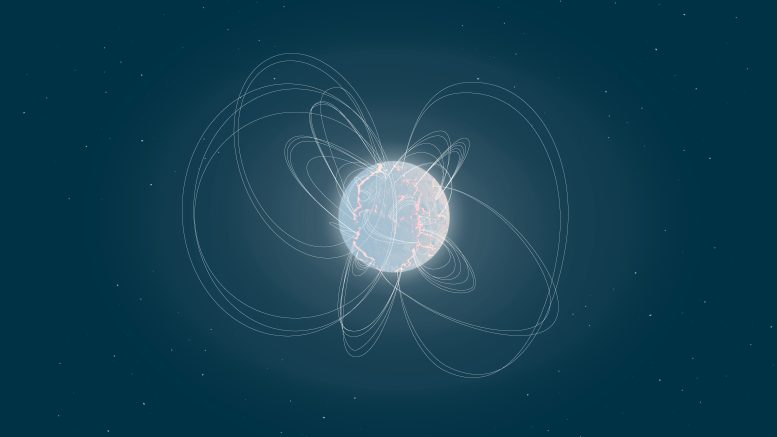
ESA’s satellites, INTEGRAL and XMM-Newton, detected and followed up on a gamma-ray burst from the nearby galaxy M82, which was identified as a flare from a magnetar—a rare type of highly magnetic neutron star. This event, captured and analyzed by an international team led by the University of Geneva, marks the first confirmed magnetar flare outside the Milky Way, furthering our understanding of these powerful cosmic phenomena. Artist’s impression of a magnetar. Magnetars are the cosmic objects with the strongest magnetic fields ever measured in the Universe. Credit: ESA
An international team, with the assistance of ESA satellites, and including researchers from UNIGE, has detected a massive eruption emanating from a magnetar, an extremely magnetic neutron star.
As ESA’s satellite INTEGRAL scanned the skies, it detected a surge of gamma-rays emanating from the nearby galaxy M82. Shortly after this observation, ESA’s XMM-Newton X-ray space telescope sought any residual glow from the event but detected nothing. An international research group, with contributors from the University of Geneva (UNIGE), concluded that the burst was an extragalactic flare from a magnetar, a young DOI: 10.1038/s41586-024-07285-4










Discussion about this post