









European Commission Unveils Quantum Act to Boost Technological Sovereignty
The European Commission introduced its Quantum Act on November 25, aiming to leverage Europe’s scientific advancements for enhanced industrial competitiveness as the global competition in quantum technology intensifies.
The proposed legislation lays the groundwork for a Sovereign Tech Equity Fund (STEF), which is intended to mitigate Europe’s scarcity of strategic growth capital and decrease technological dependencies.
“Alongside AI, cloud computing, and semiconductor technologies, quantum technology completes our strategy for ensuring Europe’s technological sovereignty,” stated Henna Virkkunen, Executive Vice-President for Tech Sovereignty, during a press briefing in Strasbourg.
Funding Disparities and Challenges
Despite being home to approximately one-third of the world’s quantum start-ups, Europe only secures about 5% of global private investment in this sector, while the United States captures a staggering 50%.
The fragmented support from national governments and limited access to investment capital leave European firms exposed to potential foreign takeovers or relocations to markets with more favorable financing conditions.
“In order to flourish, we must convert Europe’s academic excellence into scalable industrial capacity,” Virkkunen emphasized.
Aiming for a €500 Billion Investment Fund
The Commission aims to establish a €50 billion sovereign technology fund, which could potentially mobilize investments ranging from €400 billion to €500 billion to further Europe’s ambitions for technological autonomy.
“While some member states have smaller sovereign funds, when it comes to critical technologies, we often require investments in the hundreds of millions,” Virkkunen explained.
The current proposal does not designate specific funding, as the Commission plans to collaborate with the European Investment Bank, member states, and private investors to set up the fund, ideally by the commencement of the next EU long-term budget in 2028.
This fund is expected to make substantial equity investments in strategic companies and industrial initiatives, supplementing existing funding mechanisms such as the Scale Up Europe Fund.
“No company should be compelled to leave Europe due to insufficient financial resources,” Virkkunen asserted.
Details regarding eligibility criteria, geographical distribution, and potential participation from non-EU countries are still under consideration.
Transforming Research into Market Applications
The Quantum Act is built on three main pillars: research excellence, industrialization, and resilience.
A Quantum Europe Framework Initiative will coordinate national and European programs, linking top research institutions and facilitating access to shared infrastructure.
Every member state will host specialized innovation hubs and acceleration centers to assist companies in developing market-ready products, while strategic projects will focus on manufacturing and industrial deployment.
When questioned about whether the Act would exclusively support “Made in Europe” technologies, a senior official indicated that public procurement would prioritize EU-controlled entities, in compliance with international agreements and allowing for security-related restrictions on a case-by-case basis.
No new export controls beyond existing dual-use regulations will be introduced with this proposal.
Addressing Security and Supply Chain Dependencies
The Commission also aims to map critical quantum supply chains and lessen reliance on foreign suppliers.
Virkkunen pointed out that Europe does not currently produce nine of the 47 critical materials deemed essential for quantum technologies.
The legislation will also expedite the transition to post-quantum cryptography to safeguard communications, data, and critical infrastructure against future cyber threats.
“This transition to post-quantum cryptography is an urgent priority that we must address today,” Virkkunen noted.
The EU aspires to achieve quantum readiness in high-risk sectors by 2030 and in other sectors by 2035.
The European Parliament and the Council will now review the proposal.
“We want quantum technologies developed in Europe to be manufactured and utilized here while bolstering our security and preparing for a quantum-safe future,” Virkkunen concluded.
MAIN PHOTO: Henna Virkkunen speaks at a press conference regarding the Quantum Act at the European Parliament in Strasbourg, France © European Union
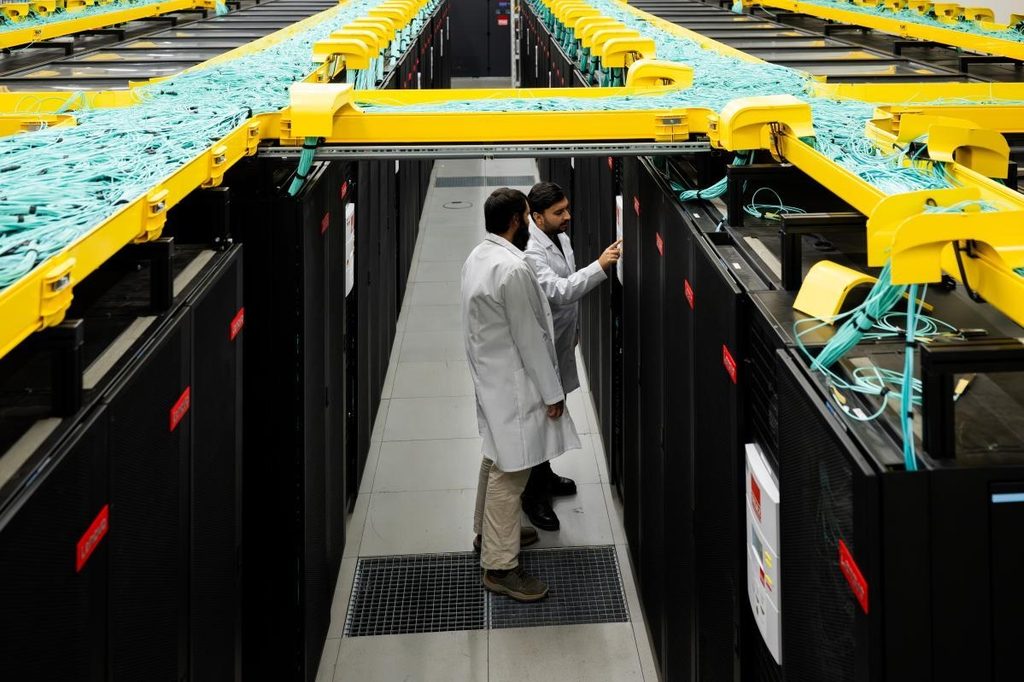
PHOTO 2: LRZ researchers examining the supercomputers integrated with an EU-funded quantum computer. Photographer: Sebastian Widmann © European Union








Discussion about this post