
Key Takeaways
- Supply chain disruptions, one of the major concerns for businesses, are costing them an average of $184 billion every year. That’s why leaders are adopting AI to automate decisions and reduce manual errors.
- AI is helping companies to move from reactive problem-solving to proactive planning. A resilient supply chain bounces back quickly after being hit by a disruption without being shut down.
- achieve 80 to 90% of accuracy, with AI tools.
- Instead of reacting to a disruption, AI gives operational leaders the ability to identify risks in advance and develop supply chain resilience strategies to continue their operations.
Introduction:
Think about the last time something went wrong in your supply chain, a supplier went silent for a week, or maybe you ran out of product when it was in demand. These events could happen in your supply chain every day.
Supply chain disruptions cost $184 billion annually, affecting manufacturers and logistics providers, and everyone in between. Companies cannot keep up with the old way of managing supply chains because damage is already done by the time you spot a problem.
This is where supply chain resilience comes in. A resilient supply chain is capable of anticipating problems before they happen and absorbing the impact when disruptions hit. The company would recover quickly from a supply chain disruption without losing its customers or revenue. In 2026, AI is the driving force behind a resilient supply chain.
The global AI in the supply chain market is expected to reach $51.52 billion by the year 2030 at an annual growth rate of 38.9%. Many businesses today know that AI matters, but they aren’t sure where to start. Learning how AI is reshaping technology and the supply chain is the first step towards building a resilient supply chain.
What is supply chain resilience?
Risk management is one of the biggest challenges in supply chains. Supply chains are interconnected; a delay in one segment of the chain network passes the effect to the entire distribution channel.
Supply chain resilience helps you maintain operations amid disruptions and ensure that your customers receive their services and products on time. Having alternate suppliers and backup inventory are some of the smart supply chain resilience strategies.
But resilience isn’t about inventory optimization alone. It is also about how it moves from one point in the supply chain to the other and reaches the customer on time. Logistics route optimization software gives live updates about traffic conditions and fuel usage.
Four things companies with supply chain resilience have:
- Teams have complete visibility across the supply chain, and they identify delays early.
- They are flexible to changes in the market demand.
- These companies are capable of building strong relationships with their partners and suppliers.
- They have policies and processes in place to have better control over their supply chain operations. Even if something goes wrong, they can act on it immediately.
Why Traditional Supply Chain Models Are Failing?
Traditional supply chains weren’t designed to handle disruptions. Before the technological advancements, companies used to rely on the same suppliers and the same lanes every year. This practice worked well when globalization was just a concept.
The efficiency of supply chains was based on how consistent the conditions were. Whenever there are disruptions in the flow of goods, like a port closure or a lack of communication from a supplier, companies can do nothing about it. This led to a loss of revenue and customer trust.
Operational leaders used to make decisions based on last quarter’s data because that’s what the system had. For example, you wouldn’t know about a delivery truck getting delayed until a customer complains about it. And you could do nothing about it even if you knew about it.
Companies weren’t able to save fuel costs or improve delivery speed when trucks got stuck in traffic. For example, when you do not track shipments in real-time, they wait at loading docks longer than necessary, increasing detention costs in the supply chain. Technology has changed how we see and manage supply chains today.
How is AI transforming supply chain resilience?
Here is the simplest way to understand how AI improves supply chain resilience.
Imagine your supply chain is a highway. Traditional management is like driving across the highway with a map printed last year, with no GPS or a radio. You will probably reach your location, but with delays, as you were stuck because of traffic and road closures.
AI is the GPS that helps you watch the road ahead in real time and spots traffic jams before you reach them, and reroutes you immediately. You will still be driving, but you are no longer blind about the way ahead of you.
That shift, from reacting to an issue to anticipating it, is what AI brings to a resilient supply chain.
AI turns disconnected data that is scattered across different systems into decisions. Machine learning algorithms analyze patterns from weather alerts and even from social media trends to predict supply chain disruptions before they occur.
That is a fundamental change in how resilience in supply chain operations works, and you are no longer responding to what happened yesterday. But you are acting according to what is about to happen tomorrow.
Generative AI is used to run digital twin simulations to test operations against several “what-if” scenarios. This allows businesses to identify vulnerabilities that could bring entire operations down. For example, you can optimize stock levels dynamically instead of reviewing them just once a year.
According to IBM research, companies using predictive analytics powered by AI have reduced forecasting errors by at least 20%. This is why supply chain resilience software has moved from something nice to have to an important operational investment.
Top AI Technologies Powering Supply Chains in 2026
In the previous sections, we defined the concept of supply chain resilience and looked at the impact of AI on supply chain operations.
There is no one AI tool that fixes everything. It is a set of technologies that fixes a part of the problem. Think of it like a hospital; you don’t have one physician to do everything. You have specialists for each department. AI tools act like specialists in a supply chain.
Predictive Analytics and Machine Learning:
-
In the past, supply chain planning was about assessing what had happened in the previous month or year. Managers used to trust their gut instincts before making a decision and hoped the future would look like the past.
Predictive analytics changed this by asking “what’s likely to happen next” instead of “what happened?” It answers that question by looking at many conditions, such as past sales patterns and weather conditions.
Machine learning is software that doesn’t come with its own rules. It finds the rules by learning from patterns in data and keeps refining them over time.
Leading companies now use predictive analytics for inventory planning and are able to achieve 80 to 90% accuracy in demand forecasting. By using traditional planning methods, you can’t get the right numbers most of the time.
AI tools are able to monitor signals like weather and supplier delays to identify disruptions before they impact your operations.
It removes the guesswork from demand planning, so you no longer have to depend on last year’s data.
Agentic AI:
- Agentic AI is an AI system that takes action on behalf of you instead of just giving instructions or recommendations.
- Agents do not wait to be asked; they spot a problem and handle it with less or no human intervention.
- This is the technology that gets the most attention in supply chain resilience in 2026.
- During research, Gartner found that supply chain executives have already deployed AI agents to automate workflows. 40% of them are planning to deploy task-specific AI agents by the end of this year. You will be surprised to know that this number was just at 5% last year.
- AI agents continuously monitor material shortages and bottlenecks in operations. They adjust the plan whenever there are any risks in the current plan.
- Agentic AI reduces the time between finding that there is a problem and someone solving it from hours to minutes due to its autonomous nature.
Digital Twins:
- Most supply chain failures happen because of vulnerabilities you missed noticing, and digital twins make it easy for you to find them.
- It is a software simulation of the physical supply chain, which you can update in real time.
- Digital twins allow your team to run thousands of “what if” scenarios, like what happens if demand spikes 40% next month, and find the best response before you face that situation.
- Resilient supply chains know about vulnerabilities on a screen and how to handle them before they disrupt the flow in the supply chain.
Internet of Things:
- In a traditional supply chain, you find out about a delayed truck or an equipment failure only after it happens.
- This is where IoT sensors come in, and they let you monitor the condition of the supply chain in real time.
- IoT sensors attached to smart shelves or RFID tags track inventory levels in real-time and keep you informed about them.
Generative AI for planning and communication:
- Almost everyone has used tools like ChatGPT in some way or another. The same technology used in tools like ChatGPT or Claude, generative AI, is used in supply chains to write contracts or reports in simple language.
- These AI tools enable non-technical teams to use the supply chain resilience software by communicating with it in plain language.
Industry Use Cases of AI in Supply Chain Resilience
AI plays different roles in different industries. Here are a few industry-specific use cases of how AI is being used to increase the resilience of supply chains.
Retail and E-commerce:
- Retail and e-commerce lead all industries in AI adoption. Almost 83% of companies use AI in their supply chain operations, and the reason is simple.
- A national retail chain that uses AI in logistics cut delivery time by 18% and saved $200,000 per year. One of the biggest benefits of supply chain resilience is that AI helps your money move faster by investing in the right inventory size.
Manufacturing and Automotive Industry:
- Every minute of unplanned downtime costs significantly in the manufacturing industry. A machine breaks down at 2 AM, and the supervisor comes to know about the issue hours later. Due to this, the production shift will be compromised and unproductive.
- AI solves this issue by using IoT sensors to detect root cause before the machine breaks down.
- PepsiCo is making virtual copies of its factories and warehouses before changing the real sites. Digital twins allow them to test layouts and workflow changes in software before implementing them in the physical facility.
Healthcare and Pharmaceuticals:
- This is the fastest-growing sector that implements AI in supply chains. A delay in medical shipment is a patient safety problem more than a business problem.
- Pharmaceutical and food supply chains are deploying digital twins to simulate and reduce spoilage and increase shelf life.
- IoT sensors track sensitive goods and ensure they are kept at the right temperatures to maintain the quality.
Food and beverages:
- The food industry is different from others as it handles products with expiry dates. You cannot go wrong with demand forecasting, as it leads to food wastage and puts the health of your consumers at risk.
- Research says that AI-driven demand forecasting reduces wastage by 20% to 30% and improves service levels by 5% to 10%. This is where a supply chain software development company can make a difference by building AI tools that help food businesses forecast better.
Logistics and Transportation:
- When a warehouse runs efficiently, logistics improve response times. According to research by McKinsey, AI-powered tools can unlock 7% to 15% additional warehouse capacity.
- A delayed shipment or an untracked vehicle is a testing moment that shows whether your supply chain holds or breaks.
- AI solutions for logistics give you real-time visibility over shipments across the world and flag issues before they interrupt your daily operations.
Benefits of AI-driven Supply Chain Resilience
Operational leaders expect the supply chains to have fewer disruptions and lower operational costs. When implemented well, AI helps you achieve both, along with happy and satisfied customers. The benefits of supply chain resilience, enhanced by AI technology, compound over time.
- AI doesn’t only detect risks, but also gives you enough time to handle them. It guarantees the seamless operation of your business without the threat of shutting down, even during disruptions.
- AI supports supply chain resilience by identifying supplier vulnerabilities and giving you options to work with multiple suppliers.
- Even though investment in AI-based tools looks expensive in the beginning, they lead to higher cost savings in the long term. By reducing waste and reviewing procurement charges, companies can improve profitability while lowering overall costs.
- Al Algorithms analyze historical and real-time data to predict demand in the future with high accuracy. The predictive analytics tools allow you to adjust the inventory and meet the demand.
Challenges Businesses Face While Implementing AI
Everything about AI looks great on paper, and they do deliver results when you implement them in the right way. But it’s not an easy process to get there. Many companies, especially those working with a supply chain software development company for the first time, need to know about the challenges they might come across while implementing AI.
- Geopolitical instability affects global supply chain management significantly. In addition, risks associated with natural disasters and transportation delays make it harder for companies to maintain supply chain resilience.
- Implementing AI in supply chains requires a significant budget, and companies cannot take this risk without proper planning. If you’re already calculating logistics software development costs, the upfront investment feels expensive for mid-sized businesses. There will be ROI, but you cannot see it immediately.
- If you don’t have full visibility into your entire supply chain operations, you’ll struggle to detect disruptions in advance.
- When you are working with legacy systems like ERPs and warehouse management tools in your supply chain, integrating them with AI is a time-consuming process.
Best Practices for Building an AI-Resilient Supply Chain
Integrating AI tools into your existing supply chain resilience software needs proper planning. Here are a few practices you need to follow to develop a resilient supply chain.
- Fix your data before implementing AI, as AI tools learn from the existing data. Data governance failures were one of the reasons why AI implementation often fails to bring the expected ROI.
- You have to begin with the most painful problem in your supply chain before investing in AI. Is it forecast accuracy or detention costs? First solve it with AI and then go to the next problem.
- Choose tools that integrate well with your existing systems, as many were not built to support real-time data flow. Working with a logistics software development company to build a custom solution, rather than buying an off-the-shelf product, makes integration simple and seamless.
- You have to start with a clear idea of what you want to achieve with AI tools. Are you trying to reduce stock-outs below a specific level? Or do you want to reduce the response time to supply disruptions? Be clear about the target before you implement AI in the supply chain.
Future Trends in AI and Supply Chain Resilience
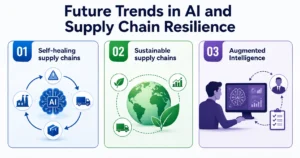
The businesses investing in AI for supply chain resilience in 2026 are not solving today’s problems alone. They are laying the groundwork for what their supply chain will look like in 2030.
Here are a few future trends for AI in supply chains that are good to know about.
1. Self-healing supply chains:
At present, most supply chains, even after implementing AI, require a human to review before acting on something. This is changing as AI is becoming more than a reporting tool.
They are now able to solve problems by identifying disruptions and solving them with minimal human intervention. This is what experts are calling self-healing supply chains, which are possible because of digital twins and AI agents.
2. Sustainable supply chains:
For years, supply chains and sustainability were treated as competing priorities. AI is changing that idea.
Even though AI-powered route optimization is bringing down fuel consumption as a cost-saving measure. It also helps to practice sustainability.
Companies that are recognized for supply chain resilience are considering sustainability as a factor behind resilience and profitability.
3. Augmented Intelligence:
According to Gartner, organizations are interested in adopting hybrid models where AI assists humans in decision-making rather than replacing them.
The idea is not to remove humans from supply chains, but to get rid of the low-value work where staff spend most of their time. In this way, human judgment will be applicable in areas where it matters the most.
Conclusion:
Supply chains have always been complex, and disruptions are no longer once-in-a-while events. A resilient supply chain outperforms disruptions increasing your credibility among your partners and customers.
By providing real-time visibility and improving the accuracy of forecasting, AI strengthens the resilience of your supply chains. The companies who does this right are not doing it alone. They are working with development partners who understands the technology and what happens if something goes wrong.
Frequently Asked Questions:
1. How does AI improve supply chain resilience?
Historical data and legacy reports were used by operational leaders to make decisions in traditional supply chains. It proved challenging for businesses to adapt to changes in a timely manner. With Artificial Intelligence, that all changes with real-time data to speed up the decision-making process. AI doesn’t just look at what has occurred, it looks forward to what is likely to happen.
For example, AI-based predictive analytics can predict changes in demand in advance and help you maintain the right level of stock. They lower the risk of hand mistakes by automatically identifying potential risks in supply chains. This is where the resilience of the supply chain helps to be more efficient and less affected by disruptions.
2. What are the biggest AI applications in supply chain management?
AI technologies are applied in various stages of the supply chain, like planning and logistics. AI’s applications are extensive, one of the prominent ones being demand forecasting, which involves analysing historical and real-time data to forecast customer demand. For example, Microsoft’s Copilot can foresee disruptions such as natural disasters or geopolitical events.
AI also aids in optimizing inventory management, minimizing overstocking and shortages. AI processes multiple parameters like traffic, fuel consumption, etc., in logistics and transportation.
3. What is the future of AI in logistics and supply chain management?
In the next few years, companies that planned for uncertain times are going to look different from those that didn’t. AI-based demand forecasting is going to be more accurate, letting you know what your customers are going to need even before they place an order. Digital twins and autonomous vehicles will become a normal thing in small and mid-level companies.


Discussion about this post