
Vulnerability detection
AI is transforming how vulnerabilities are detected. It automates the identification of flaws in code, system architecture, and APIs at a pace that significantly reduces manual effort while enhancing accuracy.
Predictive analytics
By analyzing historical data and recognizing patterns, AI models can forecast emerging threats, helping teams anticipate potential risks before they become critical issues.
Automated patching
AI-driven tools streamline remediation by autonomously identifying vulnerabilities and deploying patches in real-time, drastically reducing the time between detection and resolution.
Improved secure development practices
AI offers developers security-focused, real-time code suggestions, ensuring that secure coding practices are integrated into the development process, reducing vulnerabilities early on.
The tradeoff between faster development and greater security blind spots
AI is transforming development cycles like never before.
According to Gartner, engineering teams using AI-driven automation are now reporting up to 40% faster time-to-market.
These changes are only accelerating product releases and breaking down silos between development and security, leading to more integrated workflows. The downside is the rapid pace often results in security oversight, as speed and innovation outpace traditional risk management strategies, often leaving teams to grapple with critical blind spots.
Generative AI is not simply a tool for speeding development; it’s redefining the interplay between security and innovation.
In discussions with engineering leaders, it’s clear that companies using AI in their workflows are breaking down silos between teams. Tech firms report reducing development timelines by 30%, allowing them to scale faster.
However, as processes become more fluid, oversight often lags. This is where security blind spots emerge.
AI systems thrive on data. Large datasets—often proprietary and sensitive—are integral to training these models. The problem is that AI models operate in a black box.
A global tech giant recently faced a breach because the AI-generated code inadvertently exposed customer information. The model had been trained on internal datasets that hadn’t been fully secured. Forrester reports that 63% of organizations leveraging AI have faced similar data leaks.
Learning from breaches: The risks of generative AI in practice
These risks aren’t hypothetical. They’re very real and have already had significant impacts.
- In 2023, a tech giant suffered a breach when a customer service chatbot—built to improve efficiency—exposed personal banking details. The breach wasn’t caused by a sophisticated cyberattack but by a simple misconfiguration in the API linking the chatbot to backend systems.
- In another instance, an AI-driven healthcare tool used for diagnostics accidentally leaked patient records. The developers hadn’t anonymized the data before feeding it into the model.
These incidents underline a hard reality: AI’s speed and efficiency can create unseen vulnerabilities.
As security leaders, we know that AI offers tremendous benefits but also forces us to rethink how we protect data—particularly in areas where traditional security frameworks fall short. This shift requires not just patching gaps but fundamentally re-evaluating how we secure these dynamic, AI-driven systems from the ground up.
How security leaders are coping
Organizations are evolving their security approaches to cope with this new ecosystem.
During a recent conversation, a CISO from a major tech company mentioned how they’ve expanded their AI governance frameworks to address upcoming risks and how an AI auditing tool and designed AI-specific threat models would ensure vulnerabilities are identified early in the development process.
However, 45% of organizations still need to create a policy around the acceptable use of ChatGPT.
That said, many companies are still reacting to incidents rather than anticipating them. Gartner forecasts that by 2025, 30% of all critical security incidents will involve AI systems. This indicates that many businesses are still slow to adapt to the new, AI-driven reality of security.
Turning AI into an ally
While AI introduces new risks, it also brings unprecedented opportunities to strengthen security. In fact, AI can be a critical part of the solution. Several organizations are already using AI to detect vulnerabilities in real time.
More advanced uses of AI are emerging in the form of AI-driven attack simulations.
Recently, a security leader shared how their team has been running AI-powered adversarial scenarios, allowing them to test systems under dynamic conditions. This isn’t just about defense; it’s about proactively reshaping how we think about security testing in a world where AI and automation are rewriting the rules.
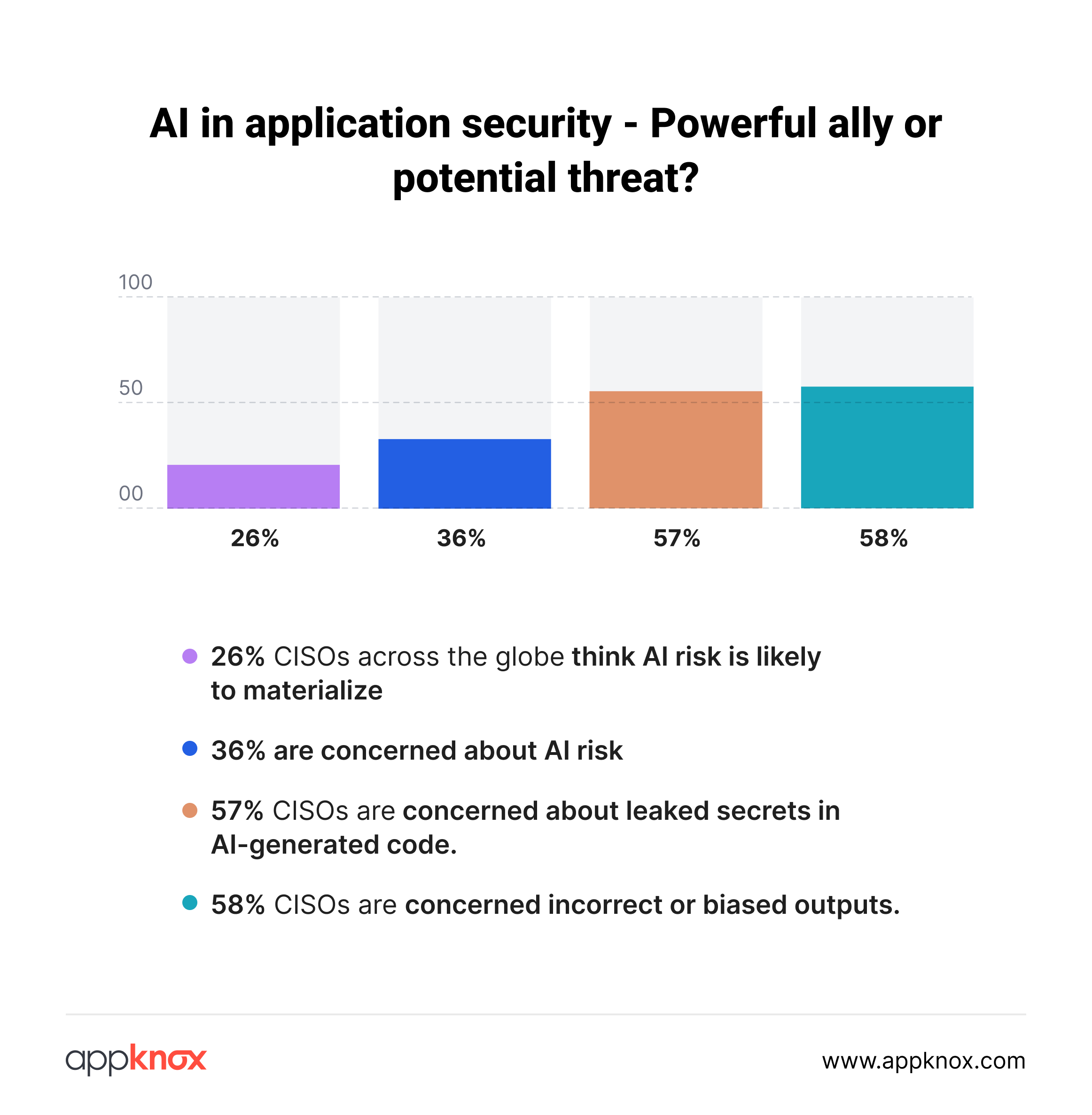
The future also points to AI automating much of the code review and patching process. This could significantly reduce friction between development and security teams, allowing them to collaborate more effectively.
AI systems that flag vulnerabilities in real-time and suggest immediate fixes are no longer a distant reality—this is where we’re headed.
Appknox’s vision for building a more secure future
At Appknox, we are rethinking how AI fits into the security landscape. We’re focusing on enhancing our security suite with AI-driven models that can predict and detect vulnerabilities faster and more accurately.
You can find a detailed whitepaper on application security in the Generative AI era, to which we’ve also added a section on how Appknox plans to help organizations worldwide leverage AI more effectively for application security.
|
Discover how generative AI is transforming the application security ecosystem with our exclusive whitepaper. Download the whitepaper |
 |
As AI continues to reshape security demands, we’re committed to staying ahead of the curve, integrating AI’s strengths while managing its inherent risks.
Rebuilding the security playbook in the era of Generative AI
Generative AI is transforming the very fabric of application security. It’s not just speeding up development; it’s fundamentally changing how organizations manage risks.
As security leaders, we must go beyond traditional security frameworks and embrace new models that recognize AI’s dual role as both an enabler of innovation and a source of vulnerability.