









Eastern U.S. Braces for Early Winter Weather
Following an extended period of unseasonably warm temperatures, millions in the eastern United States are preparing for a significant shift as an influx of cold air and storm systems is anticipated this week. High winds, chilly temperatures, rain, and the possibility of accumulating snow are expected to affect the Mid-Atlantic and Northeast regions.
The National Weather Service (NWS) reports that a pronounced dip in the jet stream will result in frigid air flowing down from Canada, causing a dramatic drop in temperatures across the eastern U.S. by late Wednesday or early Thursday. From Wednesday to Friday, The Weather Channel forecasts a potential 20-degree Fahrenheit (11 degrees Celsius) decrease in high temperatures from Chicago to Atlanta.
Enjoy the milder temperatures across the East because colder air is on the way 🥶. The next storm system will usher in high temperatures in the 40s and 50s, along with rain and blustery conditions. pic.twitter.com/y33xbgbTPu
— NWS Weather Prediction Center (@NWSWPC) November 10, 2026
As a storm system moves from the northern Plains into the Appalachian region, it is expected to intensify and extend, bringing strong winds to a broad area of the eastern U.S. by Thursday morning. Forecasters indicate that as this storm interacts with the cold front, rain may transition into wintry precipitation, with wet snow likely in the upper Great Lakes by Thursday morning.
Forecasts also suggest that a nor’easter could develop off the Eastern Seaboard by Thursday night, potentially delivering a mix of wintry weather or snow to the Mid-Atlantic and New England areas over the weekend.
Projected Snowfall and Key Areas
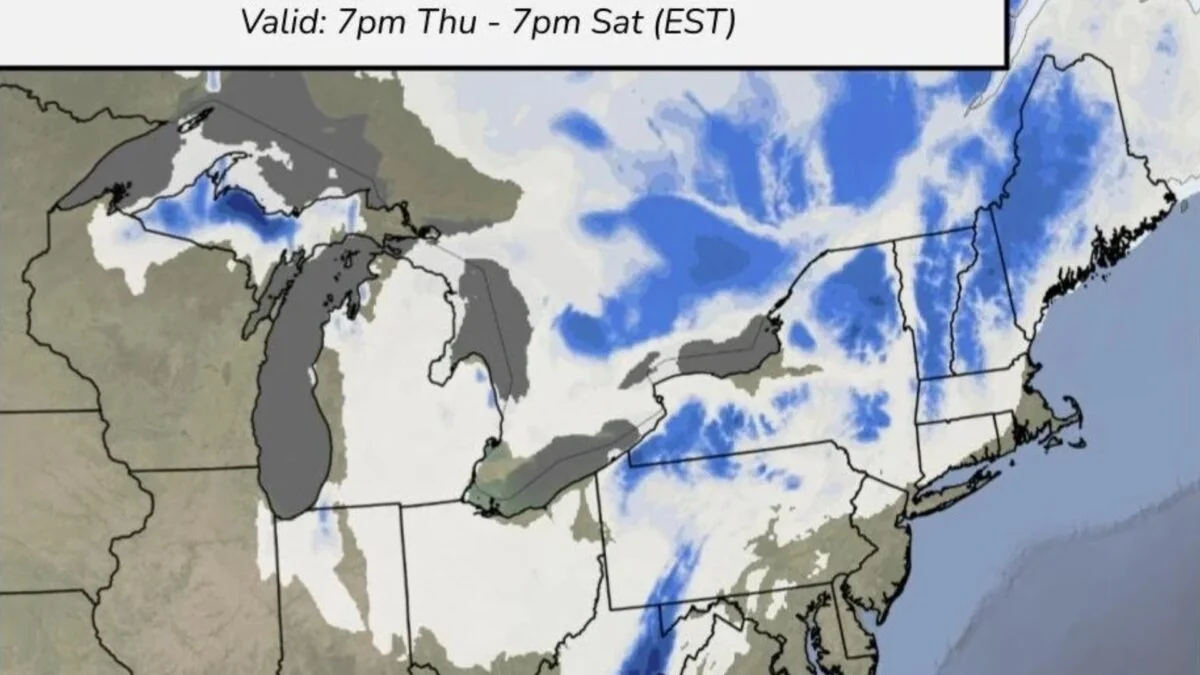
The key questions regarding snowfall amounts and affected regions remain largely unanswered as the forecast continues to solidify. The NWS has released a map indicating areas where at least 1 inch (2.5 centimeters) of snow is expected between Thursday and Saturday.
You may have heard there is a threat for snow in the Northeast/Mid-Atlantic late this week. Here is the latest information on that possibility. Please stay weather aware at https://t.co/D8jZlzOsbd for the latest on the storm! pic.twitter.com/KDBSQo5fh1
— NWS Weather Prediction Center (@NWSWPC) November 9, 2026
Significant snowfall is expected in large areas of New York, Vermont, New Hampshire, and Maine, as well as the Upper Peninsula of Michigan and a narrow strip of eastern West Virginia. While snowfall chances are lower elsewhere in the Northeast and East North Central Midwest, some accumulation is still possible.
The likelihood of snow accumulation will be greater at higher elevations, potentially benefiting ski resorts in the Northeast. Furthermore, below-freezing temperatures will aid in snowmaking efforts.
Ultimately, snowfall totals will depend on both the storm’s intensity and speed. Meteorologists at CNN note that a swift-moving storm could lead to less accumulation since precipitation would have a shorter duration in colder air. Current forecast models continue to exhibit differences regarding both storm speed and trajectory.
Understanding the El Niño Influence
This impending forecast may surprise those aware of the strengthening El Niño phenomenon, which typically brings milder winter conditions to the northern U.S. Despite this, cold temperatures and snow are anticipated in mid-November.
El Niño is not the sole factor influencing weather patterns in the northern U.S. this winter. A southward dip in the jet stream allows Arctic air to spill into lower latitudes, resulting in a stark temperature contrast between northern states and warmer southern regions—conditions that can fuel developing storm systems. As these systems travel along the jet stream, they can produce wintry precipitation when temperatures are sufficiently low.
Although El Niño may contribute to an overall milder winter, it does not preclude the possibility of severe cold and storms in the northern U.S. Forecasters warn of an imminent disruption to the polar vortex this month, suggesting that further periods of frigid weather could emerge toward late November and early December.
As it stands, attention is focused on the weekend’s forecast, with temperature and precipitation predictions expected to clarify in the coming days. Residents are encouraged to monitor updates relevant to their local weather conditions.








Discussion about this post