
The UK has beaten its target to provide £11.6bn of climate aid to developing countries by 2026 – but only through “questionable accounting”.
As part of its obligations under the Paris Agreement, the UK pledged to give at least £11.6bn in overseas “climate finance” between 2021 and 2026.
Now, Carbon Brief analysis reveals that around £2.1bn of the funds the UK counted towards this goal did not come from new spending.
Instead, the government relabelled existing funding for development banks, private-sector investment and aid for Afghanistan, Sudan and other war-torn nations as “climate finance”.
Without these changes, the UK would have fallen nearly £1bn short of its target.
Carbon Brief’s analysis is based on numerous FOI requests and reveals the otherwise-unpublished details of the UK’s climate-finance spending.
Experts and MPs say the use of “questionable” accounting shows the UK is “cutting corners” to hit its climate goals, while making unprecedented cuts to its foreign aid budget.
‘Moving the goalposts’
The UK and other developed countries are obliged under UN climate treaties to provide “new and additional” climate finance to help developing countries tackle climate change.
They also have specific targets to “mobilise” $100bn of climate finance per year through to 2025 and “at least” $300bn by 2035.
As the UK’s contribution to international climate finance, in 2019 the Conservative government pledged to provide £11.6bn between the financial years 2021-22 and 2025-26. This amounted to “doubling” its previous five-year target.
Since then, successive governments have slashed the amount of money going towards foreign aid, citing economic strain and a need for more defence spending. This has placed great pressure on the £11.6bn target, which comes from the UK aid budget.
In order to retain the target while cutting aid, the Conservative government decided in 2023 to loosen the criteria for what it defined as “climate” spending.
This enabled the UK to remain committed to the £11.6bn goal, without spending more on new climate projects, by simply relabelling existing funds. The current Labour government has opted to maintain this approach, while pledging to cut aid spending even further.
The move has been strongly criticised by campaigners, MPs and even the UK’s official aid watchdog, who have described it as “creative accounting” and “moving the goalposts”.
‘£1bn shortfall’
The UK government has announced that it met the £11.6bn target, but has not released the full details of how it did so – or even the total amount provided by 2025-26.
FOI data obtained by Carbon Brief over the course of several months reveals that, in fact, total climate finance over the past five years reached £12.8bn – with a record £4bn in the past year alone.
However, Carbon Brief analysis of government data also shows that around £2.1bn – nearly a fifth of the total – comes from the government’s accounting changes.
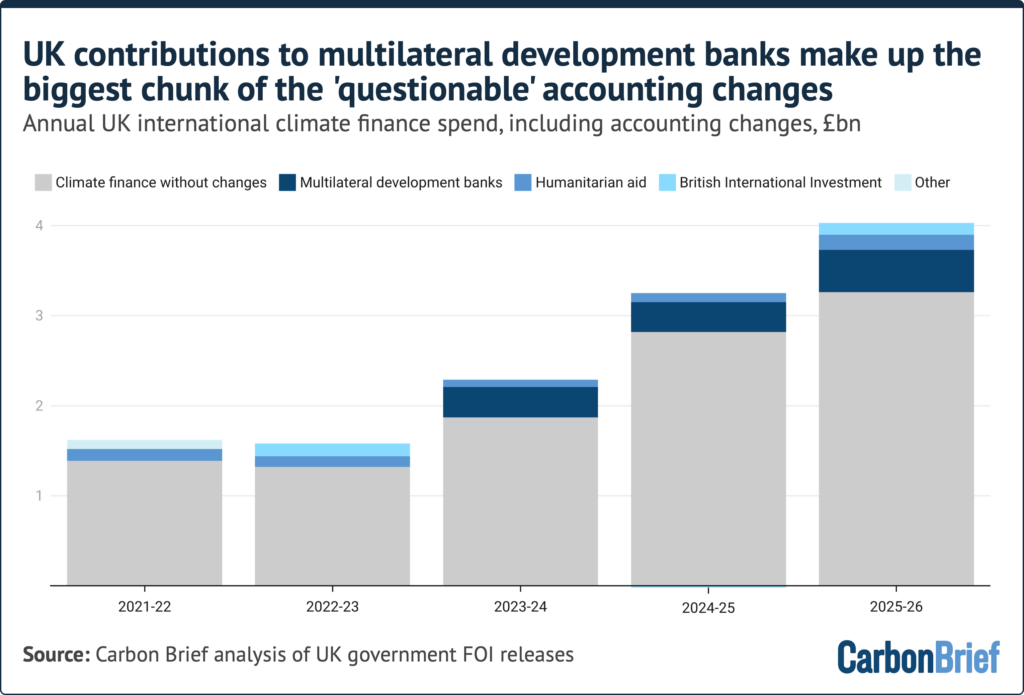
Without these changes, as the chart below shows, cumulative UK climate finance would only have reached around £10.7bn by 2026, leaving a shortfall of £924m.
This final figure of £2.1bn is higher than forecast by the UK Independent Commission for Aid Impact (ICAI), which estimated in 2024 that the total amount of “reclassified” climate finance would reach £1.7bn.
The government has stressed that its accounting changes are “consistent” with “internationally agreed ways of calculating ICF”, used by other major donors.
(Experts have noted that, traditionally, the UK was viewed as taking a more rigorous approach to climate-finance accounting, which is notoriously unregulated and opaque.)
A recent International Development Committee (IDC) report noted that developed countries have committed to providing “new and additional” climate finance to developing countries, which is generally interpreted as extra funds on top of existing aid.
Evidence gathered by the IDC concluded that, alongside aid cuts, the UK’s accounting changes have “eroded” the “additionality and credibility” of its climate finance.
Responding to Carbon Brief’s findings, IDC chair Sarah Champion said the data “shines a new light” on the committee’s findings:
“The picture is not getting any better. If questionable accounting has been used to get around a £1bn shortfall on ICF spend between 2021-22 and 2025-26, this only underlines my concerns that the government has been cutting corners to maintain headline climate-spending commitments, rather than working to deliver genuine climate and nature outcomes.”
These accounting changes remain relevant as the UK begins its next phase of international climate finance, while cutting the aid budget further.
The government has pledged £6bn of foreign aid for climate projects over the next three years. This makes the UK one of the only major donor countries to set out a new climate-finance target for the period after 2025, despite a global pledge to scale up support.
Nevertheless, the new UK goal amounts to a halving from £4bn in the financial year 2025-26 to £2bn a year, on average. Previous Carbon Brief analysis also shows that the continued use of “questionable accounting” is likely to make up around a third of the new target.
Responding to Carbon Brief’s analysis, a UK government spokesperson says:
“We are proud to have both hit, and exceeded, our third international climate-finance target – and will continue to work hard on protecting climate and nature.
“Climate change and nature loss pose a real and significant threat to global security and prosperity. That is why the UK is leading action on climate and nature, and prioritising climate finance in its aid budget.”
Accounting changes
The UK’s accounting changes break down into three major components, which are behind most of its upward revision in climate-finance spending.
The first is counting a share of “core” funding for multilateral development banks (MDBs) as climate finance.
This refers to un-earmarked contributions that governments provide to support these banks in their work, which includes providing loans and grants to developing countries.
Counting this spending as “climate finance” adds £1.1bn to the total of £12.8bn, split mainly between the World Bank and the African Development Bank.
As the chart below shows, this is by far the largest chunk of extra climate finance resulting from the UK’s accounting changes.
This revision has been justified on the grounds that the World Bank and other banks have clear targets for funding climate-relevant projects, using their core funding.
However, MDBs have also faced criticism for their lack of transparency around climate finance and their reliance on loans, rather than grants. (In contrast, nearly all of the UK’s climate finance so far has been grant-based.)
Moreover, the US has been pressuring MDBs to drop their climate plans altogether. Indeed, the Trump administration has already forced the World Bank to abandon its overall target to put 45% of its funds towards climate finance.
Jon Sward, environment project manager at the Bretton Woods Project NGO, tells Carbon Brief:
“One thing removing the overall [World Bank] target definitely does is it adds…a lack of predictability of the flows going forward.”
The second-largest UK accounting change – contributing nearly £600m – comes from automatically counting 30% of humanitarian aid as climate finance, if it is going to one of the countries judged most vulnerable to climate change.
This includes some of the most war-torn and low-income nations in the world, such as Afghanistan, Sudan and the Democratic Republic of the Congo.
Crucially, this means projects are counted even if they have no discernible link to climate change, such as helping “conflict-affected” people in Yemen and orphans in Zimbabwe.
The Center for Global Development (CGD) has described this revision as “arbitrary”, given every aid project is already screened for any climate-relevant components.
The third significant portion comes from counting more of the government’s private-sector investments via British International Investment (BII) as climate finance. BII is a publicly owned, for-profit company that invests in developing-country businesses and is partially funded with injections of UK aid money.
The UK government decided to start calculating the climate share of its BII spending based on real-world BII investments, rather than a default, fixed share of 30%.
Data obtained by Carbon Brief via FOI suggests that £133m of extra BII funding was labelled as climate finance over the first four years of the £11.6bn target.
However, government records of BII climate finance have been inconsistent, making it difficult to estimate the total impact of accounting changes. Therefore, Carbon Brief has used an earlier internal government forecast that estimated this change would add a total of £266m over the five-year target period.
BII has increasingly turned its attention to investing in clean power in recent years, reaching more than £1bn in “climate investments” in 2025.
However, the company has faced criticism for investments that “conflict” with UK priorities – including legacy fossil-fuel investments – as well as channelling aid money to “billionaires”.
There was also some extra spending that the government decided to count as climate aid – notably, £99m of “spending on COP26”, from when the UK hosted the climate summit.
Shruti Agarwal, senior climate finance adviser at Save the Children UK, tells Carbon Brief the reduction in overall “financial effort” by the UK is a “concerning pattern that must cease”. She adds:
“[The UK should] strengthen transparency by publishing timely, detailed data on international climate spending and stop classifying expenditure as climate finance retrospectively, as seen with COP26 expenses.”
Methodology
Carbon Brief obtained the full datasets of international climate-finance spending via FOI, covering the five-year period 2021-22 to 2025-26. For more details and to access the full dataset, see Carbon Brief’s analysis of the £12.8bn in spending over this period.
In addition, Carbon Brief requested details from the Foreign, Commonwealth and Development Office (FCDO) of what climate-finance spending would have been prior to the 2023 accounting changes, for the period 2021-22 to 2024-25.
Carbon Brief then used this information to calculate the impact of accounting changes in 2025-26, combining the figures to work out the full impact.
A spreadsheet with the full details of the accounting changes can be viewed here.
UK climate-finance figures have been subject to regular revisions. While this analysis is based on final figures provided via FOI requests in recent months, it is possible that departments will still change the figures in future releases.
UK budget 2026: Key climate and energy announcements

Analysis: How the UK spent more than £11.6bn on climate aid since 2021
Q&A: Why are UK energy bills so high – and how could they be lowered?



Discussion about this post