
Reusable for up to 25 different calculations, a DNA computer points toward possible uses in energy-efficient computing and long-term data storage.
A DNA computer has added 10 and 3 in 30 seconds, using interacting strands in water instead of a silicon chip. Developed by researchers at Maynooth University (MU), the system can also multiply and divide without a continuous electricity supply.
The work, published in Nature, presents a first-of-its-kind system described as one of the most complex and fastest molecular computers yet reported.
DNA strands assemble the answer
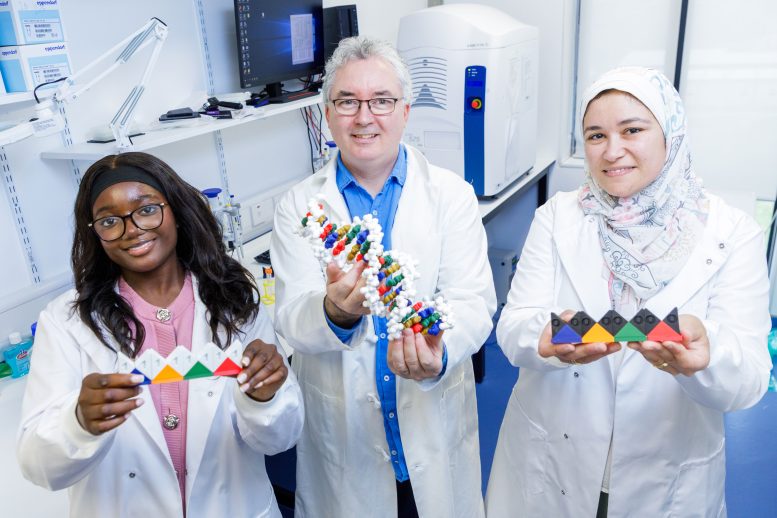
Dr Abeer Eshra, an assistant professor and computer scientist at MU’s Hamilton Institute who conducted many of the experiments, described what is happening inside the liquid. “A small droplet of liquid contains billions, and sometimes trillions, of DNA strands. These strands interact with one another to produce a result.”
To build the computer, the team combined a small drop of water and salt with short pieces of DNA and a longer DNA scaffold in a test tube. The mixture needs only a little heat to get started and is then cooled, allowing the computation to proceed.
“The molecules interact, form a structure and that structure is the answer,” said Professor Damien Woods of MU’s Hamilton Institute. “One key innovation is that the system naturally finds that answer without needing continuous energy inputs,” he added.
Fast for DNA, slower than silicon
The researchers ran ten programs, including 100-bit computations. In one experiment, the computer added numbers in the range of about 11 million to 34 million, taking up to 14 hours to reach a result. The system also demonstrated robustness and reusability, performing up to 25 different calculations in a row.
“The reaction happens fast in the test tube, but not as fast as silicon, nor is it intended to be. But compared to other DNA computers, ours is the fastest,” said Eshra, joint first author of the Nature study alongside Dr Tristan Stérin. The paper’s coauthors also included Senior Research Fellow Dr Constantine Evans and undergraduate researcher Janet Adio.
Molecular computers could work inside cells
Beyond arithmetic in a test tube, the research points to possible applications in long-term data storage and energy-efficient computation. In time, molecular systems might also operate inside cells for tasks such as disease detection.
Woods explained the motivation for exploring other forms of computing. “Silicon-based computers use so much energy – 23% of Ireland’s electricity goes into computing and data storage. We’ve been blinkered by only seeing one type of computer, but there are other examples around us, including our brain.”
Maynooth’s DNA computing research is supported by a €4 million European Innovation Council grant led by Woods. The DISCO project, DNA-based infrastructure for Storage and Computation, aims to develop new ways to compute and store data using DNA technology.
“This is blue skies science. We don’t know where the future is going to take us.” Woods offered that perspective on the broader effort to explore alternative forms of computing.
Reference: “A thermodynamically favoured molecular computer” by Tristan Stérin, Abeer Eshra, Constantine Glen Evans, Janet Adio and Damien Woods, 16 September 2026, Nature.
DOI: 10.1038/s41586-026-10996-5
This research work was supported by the European Research Council of the European Union (ERC, Active-DNA, no. 772766), the European Innovation Council (EIC, DISCO, no. 101115422), the Science Foundation Ireland under grant nos. 18/ERCS/5746 and 20/FFP-P/8843 and Research Ireland (24/PATH-S/12367).
Never miss a breakthrough: Join the SciTechDaily newsletter.
Follow us on Google and Google News.
Discussion about this post