









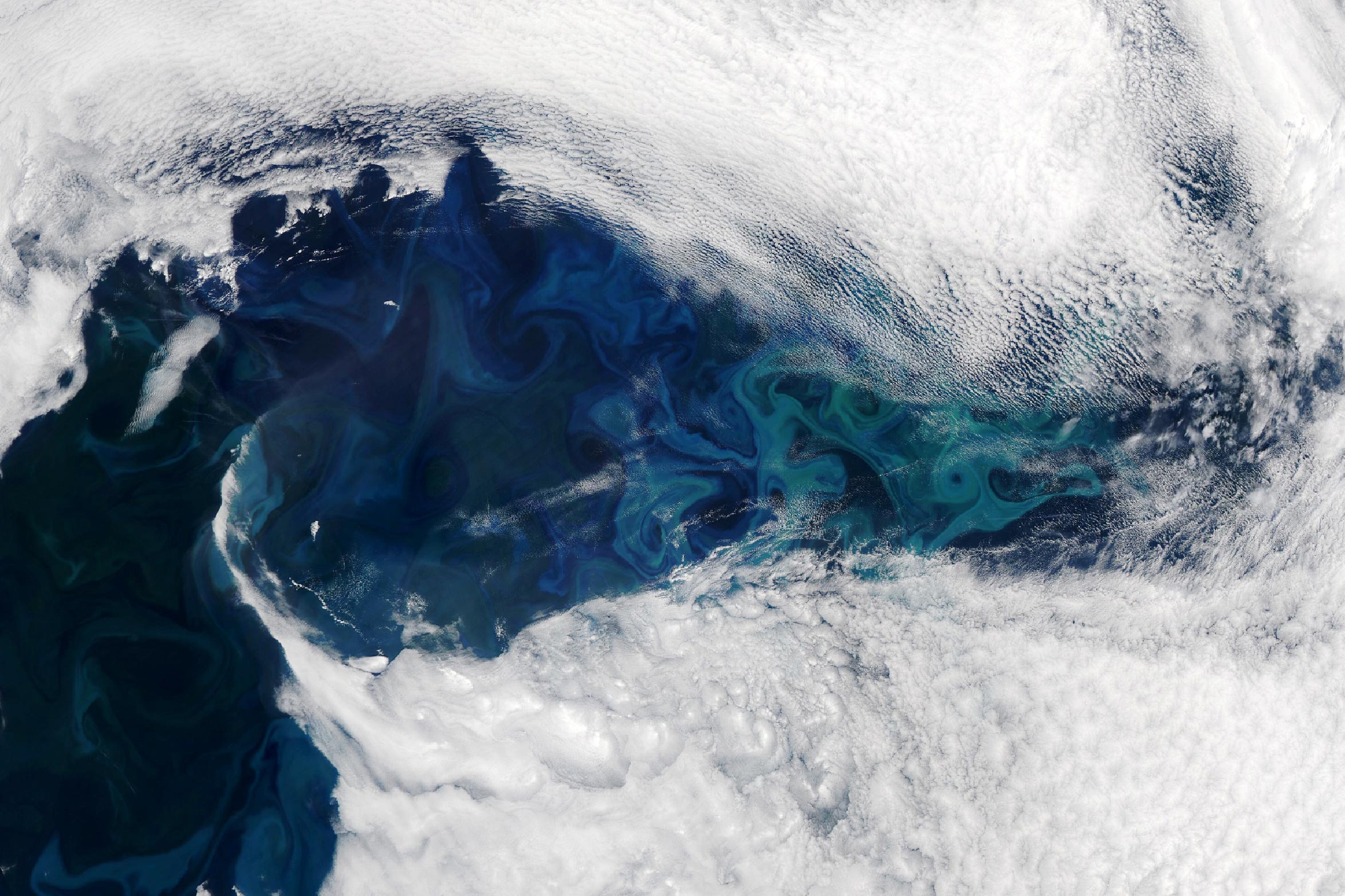
Satellite image of a striking phytoplankton bloom in the North Atlantic captured on June 16, 2024, by the Moderate Resolution Imaging Spectroradiometer on NASA’s Aqua satellite.
A short-lived gap in the clouds let satellites observe a stunning phytoplankton bloom east of Greenland.
Satellite observations revealed a vast phytoplankton bloom off Greenland’s coast, possibly composed of coccolithophores or diatoms, key players in marine ecology and atmospheric carbon regulation.
Since May 2024, satellite images have hinted at a phytoplankton bloom developing off the coast of southeast Greenland. But a near-constant stream of clouds prevented optical sensors from getting a clear look. That changed in mid-June, when a short-lived gap in the clouds over the North Atlantic Ocean exposed the bloom’s colorful swirls.
The bloom is visible in this image, acquired on June 16, 2024, with the MODIS (Moderate Resolution Imaging Spectroradiometer) on 
Phytoplankton, the tiny plant-like organisms that float in aquatic environments, are more than just food for marine life. They are essential players in the Earth’s biosphere, engaging in photosynthesis to produce oxygen and consume carbon dioxide, thus influencing both local and global climates.
A bloom is essentially an abundance of phytoplankton—tiny, plant-like organisms that often float near the ocean surface. Phytoplankton fuel the ocean by feeding other plankton, fish, and ultimately bigger creatures. They are also important carbon cyclers and oxygen producers.
The type of phytoplankton present in this bloom cannot be identified based on this natural-color image alone. The bloom might contain coccolithophores, which are plated with white calcium carbonate that can give the ocean a milky hue. It could also contain diatoms, a microscopic form of algae with silica shells and plenty of chlorophyll, which has a green pigment.
Whichever









Discussion about this post