









By
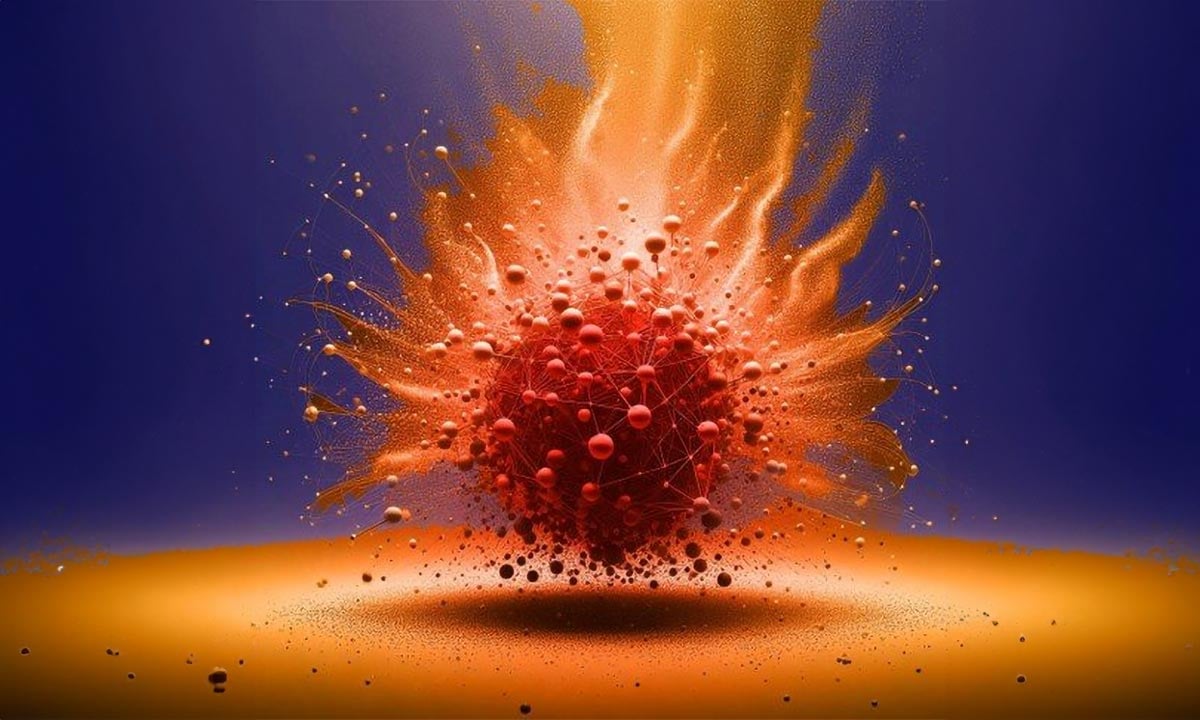
Artist’s depiction of the spray of particles arising from the collision of two heavy atoms. As the hot subatomic soup cools, newly formed particles shower off into space. Credit: Joseph Dominicus Lap, edited
Scientists have recreated the extreme conditions of the early universe in particle accelerators, revealing surprising insights about the formation of matter.
New calculations show that up to 70% of certain particles may originate from later reactions rather than the initial quark-gluon soup formed just after the DOI: 10.1016/j.physletb.2023.138246
This work was supported by the Department of Energy Office of Science, Nuclear Physics program. One of the researchers also acknowledges the hospitality and financial support provided during a sabbatical stay at Yale University.









Discussion about this post