
JUST IN: Ukraine Reps Make Arduous Journey to Qatar Trade Show
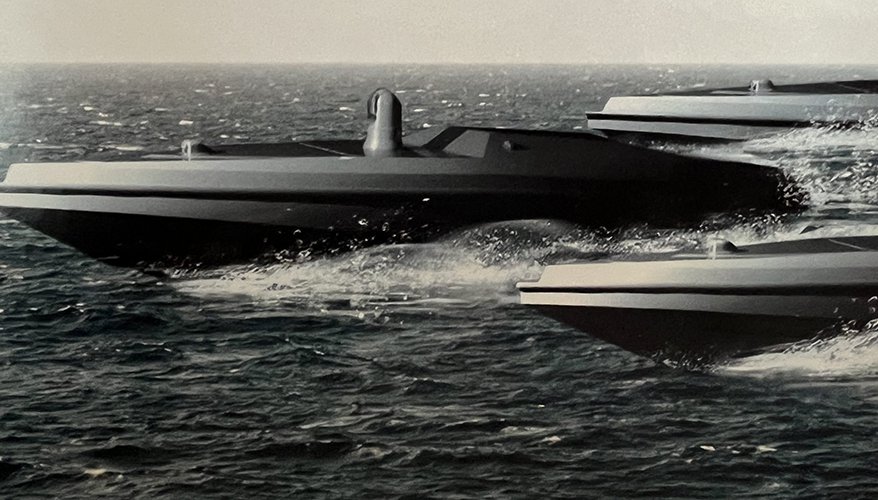
Illustration of MAGURA V5 credit Spets Techno Export
Magura image
DOHA, Qatar — It took Viktor Lystopadov and his three fellow business executives three days to travel from Kyiv to Doha, Qatar to participate in the Middle East’s largest maritime trade show.
Since Ukrainian airspace has been closed to commercial flights due to the war, it took a series of planes, trains and automobiles and about 72 hours to bring the representatives of Spets Techno Export to the Doha International Maritime Defense Exposition and Conference, or DIMDEX, to tout weapon systems that it is not actually selling at the moment.
“Everything here is made in the Ukraine and developed over the past two years during the war,” Lystopadov, a regional director at the company, said in an interview March 5 next to the company’s modestly sized trade booth. A video display of its small kamikaze drones honing in on Russian soldiers and armored vehicles and blowing them to pieces played in the background.
It’s an effective, if not sobering, sales tool.
But since Ukrainians need all the weapons they can put their hands on, none of the half-dozen or so technologies the company brought to the show are for sale — yet. Each of the products was developed out of necessity in Ukraine to solve specific battlefield problems.
There will be a day when the war ends and Ukraine can return to exporting its military weapon systems, he said. But in the future, Spets, an arm of the Ukraine Ministry of Defense, will have technology tested in real-world operations to offer.
Top of the brochure rack and on display on the TV screen was one of the most famous technologies to emerge from the war, the MAGURA V5, a multi-role autonomous surface boat that has been used to take 10 Russian naval vessels out of the war.
It is about 18 feet long, five feet wide with an 18-inch profile above the waterline and can slam into a target at speeds up to 42 knots. All that and it can carry a 700-pound payload of sensors or explosives.
“Just last night the MAGURA made a Russian ship scuttle,” he said. Lystopadov later showed National Defense a video of the attack as seen through a FLIR-like camera. As the kamikaze boat sped toward the ship, the splashes of heavy machine gun fire sprayed in the water in front of it. But the Russians’ aim wasn’t good enough. The MAGURA slammed into the stern where the engines are placed.
A video taken from a second boat showed the explosion, and then later about three-fourths of the ship underwater with the aft sticking up.
The Associated Press, citing Ukrainian intelligence officials, said it was the Sergey Kotov patrol ship. The attack reportedly killed seven crew members, injured six with 52 rescued. The numbers couldn’t be independently confirmed, the news service said.
The Sergey Kotov was the 11th Russian ship destroyed by Ukrainian forces and the third in the past two months, Lystopadov said.
Small enough to carry to the trade show was the JET drone, which is designed for reconnaissance and carrying a small amount of supplies to hard-to-reach places. It can travel at 100 kilometers per hour for 13 minutes and is equipped with electronic countermeasures to thwart Russian defenses.
The offensive version was prominently featured in the marketing video repeatedly striking Russians on foot or in fighting vehicles. So far, Spets is not having any issues obtaining the parts needed to produce the drones, he said. The company is producing about 1,000 per day, he said, but because of Russian electronic warfare and other issues, only about three or four of every 10 reach their target.
Along with the naval and aerial drones, Spets was promoting the EDM4S Skywiper counter-drone gun — which uses a jammer to stop small unmanned aerial vehicles — a thermal weapon sight, an antenna system and a truck-mounted jammer for electronic warfare.
The main item Ukraine needs now is ammunition, followed closely by armored vehicles, he said. He declined to list any other specific needs. “We need everything,” he said. “Just give us what we need, and we will use it to defeat our mutual enemy.”
About a football field length away from the Spets display was the booth for Iran’s Ministry of Defense, which according to open sources has been supplying Russia with arms such as the Shahed-136 drone to attack Ukraine.
Lystopadov said he had taken a look at the Iranian booth. “The UAVs, they are not expensive, but they’re very effective. It’s very hard to fight them.”
Topics: International


Discussion about this post