









Caribbean Debt Reaches US$91.7 Billion Across Ten Nations
By News Americas Now Business Editor
MIAMI, FL, November 20, 2026: A recent analysis from the World Bank’s International Debt Report 2026 reveals that ten Caribbean nations collectively owe a staggering US$91.7 billion in external debt as of the end of 2025. Notably, the countries with the highest debt do not necessarily face the most significant repayment challenges.
Debt Rankings by Country
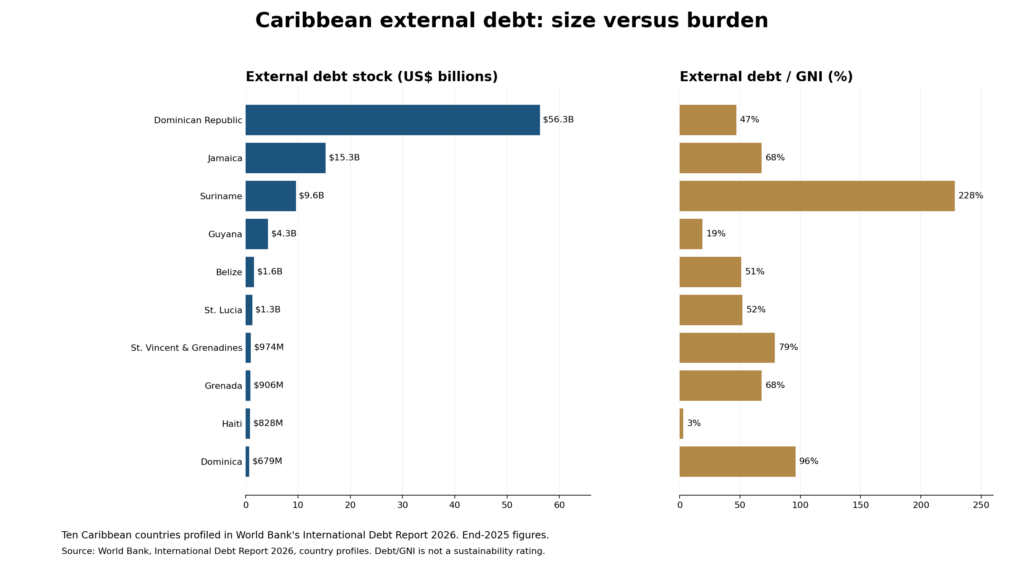
The Dominican Republic leads the debt rankings with an outstanding amount of US$56.3 billion, followed by Jamaica at US$15.3 billion and Suriname at US$9.6 billion. Guyana holds the fourth position with US$4.3 billion, while Belize reports a debt of US$1.6 billion, according to insights from Invest Caribbean.
The remaining five countries are identified as follows:
- St. Lucia: US$1.3 billion
- St. Vincent and the Grenadines: US$974.4 million
- Grenada: US$905.8 million
- Haiti: US$827.5 million
- Dominica: US$678.6 million
It is important to note that the US$91.7 billion figure reflects only the debt of the ten countries profiled and does not encompass the total external debt of the entire Caribbean region. Countries such as Antigua and Barbuda, The Bahamas, Barbados, St. Kitts and Nevis, and Trinidad and Tobago are not included in this report.
Debt Service Pressure
Jamaica, while second in total external debt, faces the highest debt-service-to-exports ratio at 54 percent, indicating significant repayment pressure. Suriname follows closely with a ratio of 44 percent, despite its third-place rank in total debt.
This ratio compares annual debt repayments to export earnings, providing a critical perspective on the external repayment obligations faced by these nations.
Suriname’s Rapid Debt Growth
Suriname has experienced the most dramatic increase in debt among the ten countries, with an external debt surge of 37.2 percent, bringing its total to approximately US$9.6 billion. In contrast, Jamaica’s debt stock rose modestly by 1.8 percent, maintaining a high repayment burden with a debt-service-to-GNI ratio of 18 percent.
Guyana’s Favorable Debt Indicators
Guyana presents a contrasting scenario. Although its external debt increased by 16.3 percent to US$4.3 billion, its debt-service-to-exports ratio is only 3 percent, indicating manageable repayment obligations despite the rising debt levels.
Debt Ownership Dynamics
The data illustrates stark differences in creditor profiles across the Caribbean. The Dominican Republic, Jamaica, and Suriname are heavily reliant on private creditors, with private entities holding a substantial portion of their external debts. Conversely, smaller nations such as Dominica and Haiti predominantly owe debt to multilateral lenders, including institutions like the Inter-American Development Bank and the World Bank.
Debt Burdens of Smaller Economies
Interestingly, smaller economies can bear significant debt burdens relative to their GDP. For instance, while Dominica has the lowest absolute debt at US$678.6 million, this amount represents a staggering 96 percent of its GNI.
Haiti’s Debt Decline
Haiti stands out as the only country among the ten to experience a reduction in external debt, which fell by 12.7 percent to US$827.5 million in 2025. However, the report does not clarify the reasons behind this decrease, and a lower debt level should not be misconstrued as an indicator of economic strength.
Conclusion: Understanding Debt Pressure
The findings from the World Bank underscore that the sheer size of debt does not fully capture the complexities of economic pressure faced by these nations. While the Dominican Republic leads in total debt, Jamaica and Suriname grapple with significant repayment challenges relative to their economic capabilities. Guyana, despite rising debt levels, enjoys a relatively low burden, while smaller economies contend with substantial debt-to-income ratios.
Related Insight
Recent reports suggest that trade potential between Africa and the Caribbean could reach $1.65 billion annually by 2030, highlighting the importance of economic collaboration in addressing these debt challenges.







Discussion about this post