
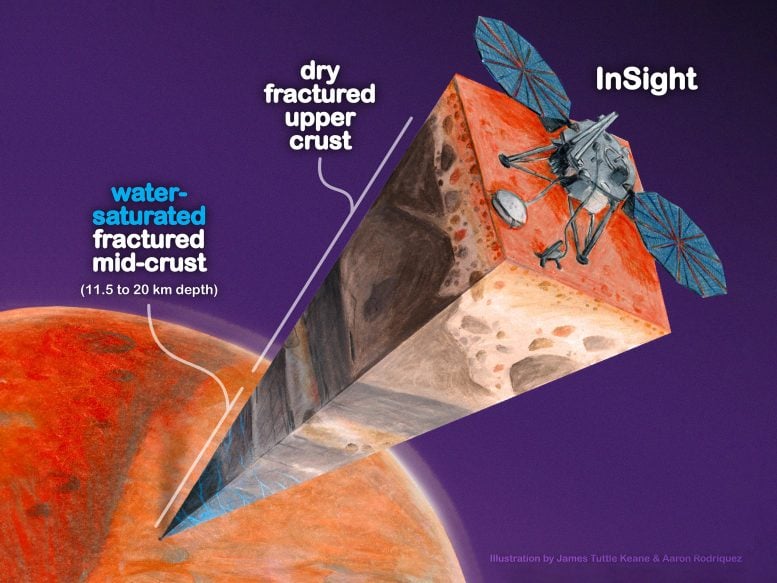
A cutout of the Martian interior beneath NASA’s Insight lander. The top 5 kilometers of the crust appear to be dry, but a new study provides evidence for a zone of fractured rock 11.5-20 km below the surface that is full of liquid water — more than the volume proposed to have filled hypothesized ancient Martian oceans. Credit: James Tuttle Keane and Aaron Rodriquez, courtesy of Scripps Institute of Oceanography, edited
Recent findings from the 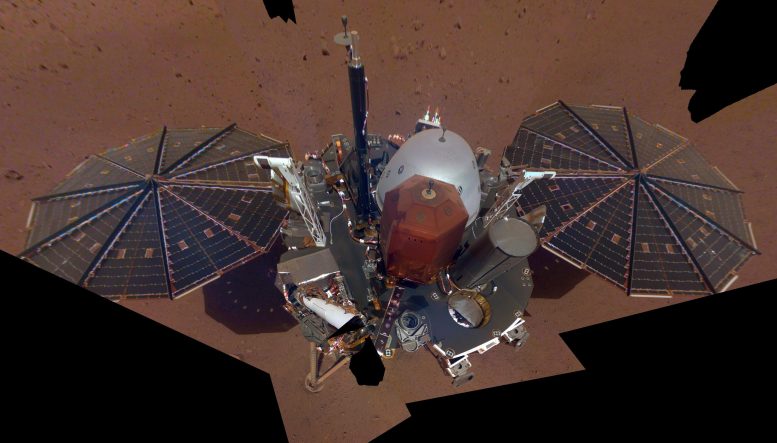
This is NASA InSight’s first full selfie on Mars. It displays the lander’s solar panels and deck. On top of the deck are its science instruments, weather sensor booms, and UHF antenna. The selfie was taken on December 6, 2018 (Sol 10). Credit: NASA/JPL-Caltech
The study appears the week of August 12 in the journal Proceedings of the National Academy of Sciences. The Canadian Institute for Advanced Research, the National Science Foundation, and the US Office of Naval Research supported the work. Besides Wright, study authors are Matthias Morzfeld from Scripps Oceanography and Michael Manga from the University of California Berkeley.
Wright’s team used data that InSight collected during a four-year mission ending in 2022. The lander collected information from the ground directly beneath it on variables such as the speed of Marsquake waves from which scientists can infer what substances reside beneath the surface. The data were fed into a model informed by a mathematical theory of rock physics. From it, the researchers determined that the presence of liquid water in the crust most plausibly explained the data.
“While available data are best explained by a water-saturated mid-crust, our results highlight the value of geophysical measurements and better constraints on the mineralogy and composition of Mars’ crust,” the authors wrote.
Reference: “Liquid Water in the Martian Mid-Crust” 12 August 2024, Proceedings of the National Academy of Sciences.
DOI:10.1073/pnas.2409983121