









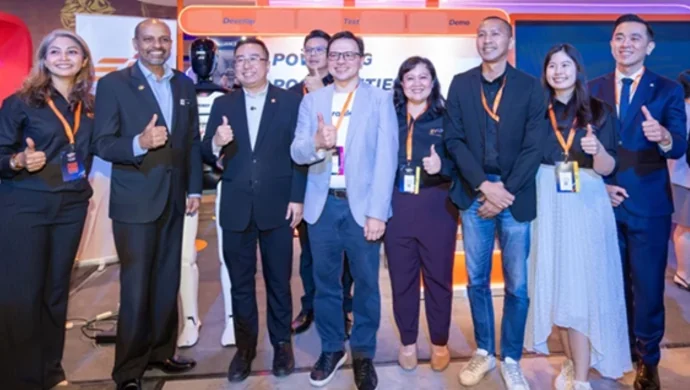
U Mobile Collaborates with Cradle Fund to Empower Malaysian Startups in 5G-Advanced Innovation
As Malaysia’s second 5G operator, U Mobile is taking significant steps to engage startups in the development of innovative solutions tailored for its network. On Friday, the company announced an expansion of its Enterprise Innovation Platform (EIP) in partnership with Cradle Fund, a government-affiliated agency that supports startup growth.
Joint Initiative Fosters 5G-A and AI Solutions
The partnership delineates clear responsibilities: Cradle Fund will provide a pipeline of startups paired with various programs and potential funding avenues, while U Mobile will offer access to a 5G-Advanced (5G-A) and AI sandbox, along with technical expertise and connections to enterprise clients.
5G-A represents the next evolution of 5G technologies, marked by improvements in latency, upload speeds, and device positioning accuracy—benefits that are crucial for industries such as manufacturing and logistics, rather than just consumer entertainment.
However, U Mobile clarified that access to specific sandbox features is contingent on technical requirements and engagement; thus, this initiative functions more as a testing environment than as a financial investment platform.
U Mobile’s Ambitious Network Reach and Challenges
U Mobile’s position as a competitor in Malaysia’s telecommunications sector was solidified when it secured the country’s second 5G network license on November 1, 2024. By March 31, 2025, the operator had officially received its award letter, and as of September 2026, its network coverage had expanded to 90% of populated areas, rising from 80% earlier that year. The company has also been recognized by Ookla as the fastest 5G network in Malaysia and is a joint recipient of reliability accolades from Opensignal.
Despite the impressive coverage statistics, monetization remains a challenge, with many Asian operators struggling to convert their investments in 5G into substantial revenue. Real opportunities lie within enterprise solutions, such as private networks and industrial IoT, which necessitate applications that startups are well-positioned to develop.
Support for Startups with Real-World Applications
“Malaysia has a wealth of bold ideas and gifted innovators. Startups require a conducive environment to test their solutions and address genuine business challenges,” stated Woon Ooi Yuen, U Mobile’s Chief Technology Officer. He further highlighted that the collaboration with Cradle Fund would serve to enhance accessibility to EIP’s capabilities in 5G-A and AI, thereby enabling startups to showcase their innovations to potential business clients.
Cradle Fund’s Vision for Regional Growth
Norman Matthieu Vanhaecke, Group CEO of Cradle Fund, underscored the agency’s commitment to creating an ecosystem that empowers Malaysian companies to thrive in markets beyond their borders. “We aspire to see more Malaysian startups develop the scale and competitiveness necessary for success both regionally and internationally,” he remarked.
Cradle has established a track record of partnerships, including a recent collaboration with Invest India, aimed at strengthening the ties between the two nations’ startup ecosystems. The ongoing Cradle Roadshow in Sarawak and the MYStartup Pre-Accelerator Demo Day are part of this vision.
Favorable Environment for Startup Development
With the introduction of Budget 2027, which allocates $110.4 million to startups, and the government’s AI Nation 2030 initiative promoting B2B AI adoption, conditions are ripe for fostering innovation. However, concerns have been raised that Malaysia’s public investment struggles to attract adequate private capital.
The sandbox initiative is especially valuable for early-stage founders who face the high costs associated with acquiring testing equipment and accessing network capabilities. For U Mobile, every startup harnessing its infrastructure presents a pathway to potential enterprise contracts.
Competitive Landscape in Telecommunications
U Mobile faces stiff competition as other telecom giants, such as Singtel with its $250 million AI fund, and the Philippines’ Globe, also seek to attract startups into their ecosystems. While U Mobile currently focuses on providing infrastructure, rivals are directing substantial capital into startup initiatives.
The question remains whether telcos will emerge as partners, customers, or competitors to the founders they seek to engage.
Measuring Success Beyond Demo Days
The real gauge of success for this collaboration will be the conversion of sandbox initiatives into paid enterprise agreements. As details regarding the number of startups involved and intellectual property agreements remain undisclosed, founders will be keen to discern whether this endeavor represents a genuine launchpad or merely showcases U Mobile’s network capabilities.
For now, Malaysian startups have access to a high-speed network for experimentation, yet the true test lies in whether commercial opportunities will materialize as a result of these initiatives.
The insights presented in this article highlight the evolving landscape of telecommunications in Malaysia and the ongoing efforts to foster innovation through strategic collaborations.









Discussion about this post